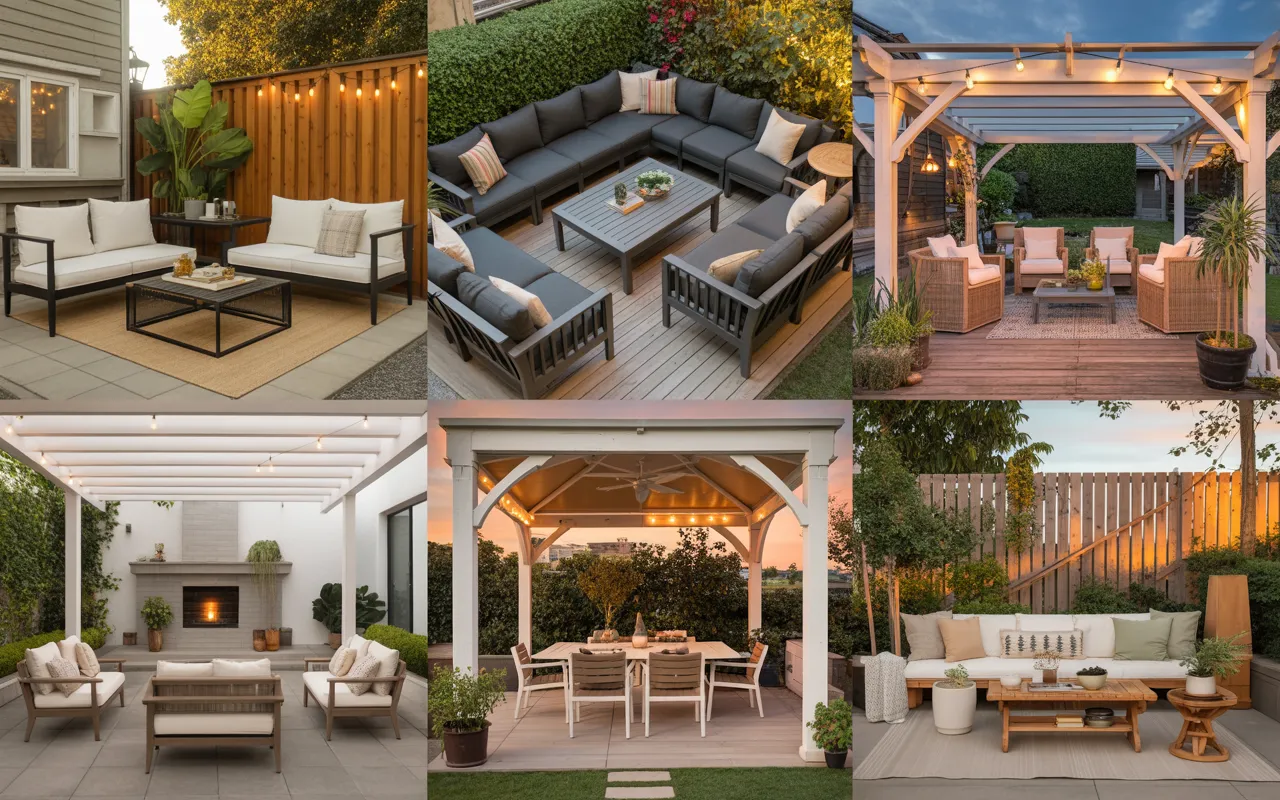
25 Outdoor Patio Furniture Layout Ideas
The best outdoor patio furniture layout isn’t determined by how much furniture you own—it’s how thoughtfully you arrange it to create functional, inviting zones that draw people outside. This article gives you 25 concrete outdoor patio furniture layout ideas: from intimate conversation groupings to family-centered dining arrangements, weather-resistant material choices, layered lighting approaches, and solutions for awkward-shaped or small outdoor spaces.
Imagine stepping onto your patio and instantly feeling the pull to stay. A well-arranged outdoor space has rhythm. It breathes. There’s room to move, yet every seating area feels intentional, nestled, like someone planned this conversation to happen. That’s what thoughtful outdoor patio furniture layout creates—not just a place to sit, but a space that invites you to linger. Whether your patio is a compact corner balcony or an expansive deck, strategic outdoor patio furniture layout transforms it from bare concrete into an outdoor room worth saving. Here are 25 ideas worth saving—and stealing.
Why Outdoor Patio Furniture Layout Works So Well
Patio furniture layout is the practice of arranging outdoor seating, dining, and lounging pieces to maximize both functionality and flow across an exterior space. Unlike indoor rooms with fixed walls and doorways, outdoor patios are open-ended environments where the quality of the layout determines whether guests naturally gather or scatter. This discipline draws from landscape architecture, spatial planning, and hospitality design—the same principles that make public plazas feel welcoming and resort pools feel like getaways.
The most successful outdoor layouts prioritize materials built for climate exposure: powder-coated aluminum frames (lightweight, rust-resistant), teak and recycled poly lumber (naturally weatherproof), sunbrella or solution-dyed fabrics (UV and moisture resistant), and ceramics or composite stone (unaffected by temperature swings). Color-wise, outdoor spaces work best with grounded palettes—warm grays, warm whites, soft terracotta, dusty sage, charcoal, warm taupe—that coordinate with plants and architecture without competing with natural light shifts throughout the day.
Style at a Glance: Outdoor Patio Furniture Layout
| Element | Core Trait 1 | Core Trait 2 |
|---|---|---|
| Philosophy | Function first, beauty through arrangement | Create distinct zones, not empty sprawl |
| Materials | Weather-resistant, low-maintenance | Natural or neutral tones |
| Color Palette | Warm white, soft gray, taupe, terracotta | Coordinates with landscape, not competing |
| Lighting Approach | Layered—ambient, task, and accent | Extends usability into evening hours |
| Scale Principle | Furniture sized to actual space, not catalog photos | Negative space as important as filled space |
1.Standing Height Bar + Seating Mix
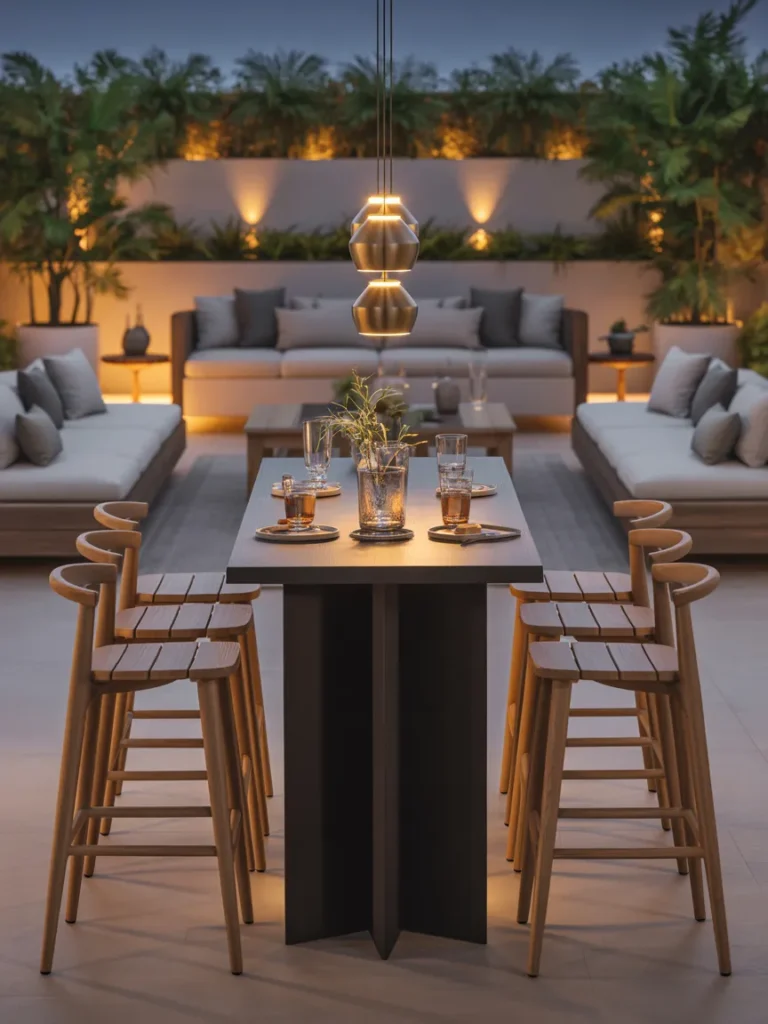
Vibe: Social and energetic.
Why it works: A standing-height bar becomes the natural gathering point for entertaining, where guests naturally cluster. Combining bar seating with lower lounging pieces nearby creates flexibility—people can stand and chat, perch on stools, or migrate to comfortable seating. This layout maximizes entertaining capacity on moderate patios while maintaining comfortable zones.
How to get it: Install or position a standing-height bar (36-42 inches) as the focal point, ideally near your patio entry or kitchen access. Add 3-4 bar-height stools with backs around it. Position lower lounge pieces 6-8 feet away as a secondary gathering zone. Overhead pendant lighting above the bar signals its purpose and extends evening usability.
💡 Quick Win: A simple high-top table (36-42 inches tall) + bar-height stools costs less than a custom bar and creates the same entertaining energy—works even on small patios.
Shop The Look
- High-top bar table outdoor 36-42 inch height clean lines
- Bar-height stool set with backs outdoor weatherproof 4 pieces
- Pendant light fixture overhead bar area warm Edison bulb
- Lower lounge seating visible beyond bar modern comfortable
- Potted plant pair framing bar area tall greenery
2.Curved Seating Flow
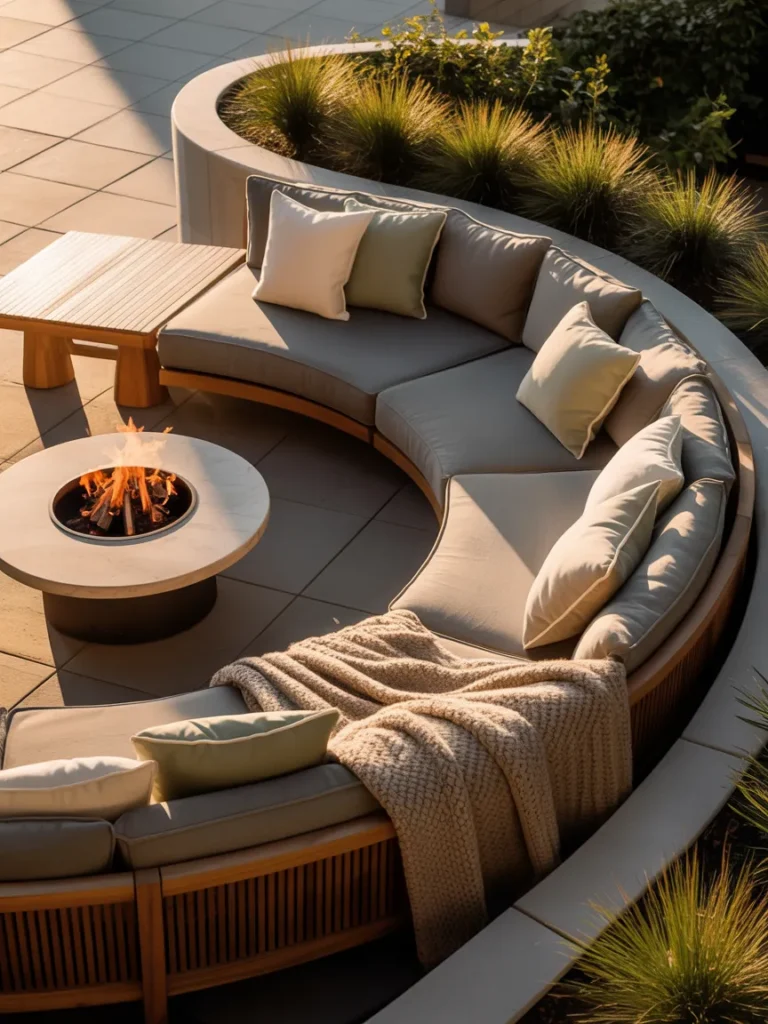
Vibe: Flowing and organic.
Why it works: Curves feel more inviting than right angles—everyone can see everyone without formal hierarchy. A curved arrangement around a central focal point (fire feature, water feature, or simply a low planter grouping) creates an amphitheater effect where conversation naturally gathers. This layout works especially well for entertaining groups of 6+.
How to get it: Sketch a gentle arc on your patio (imagine a tire being laid down gently). Arrange seating pieces along that imaginary line, all oriented toward a central point. Don’t force mathematical perfection—organic curves feel more natural. Spacing should allow for a 4-foot radius from the center.
Quick Win: If you can’t find a curved sectional, use three separate seating pieces (loveseat, two chairs) and angle them to create a curved effect—costs less and feels just as intentional.
READ MORE; 25 Summer Tablescapes for a Chic Seasonal Look
3.Warm White + Terracotta Palette
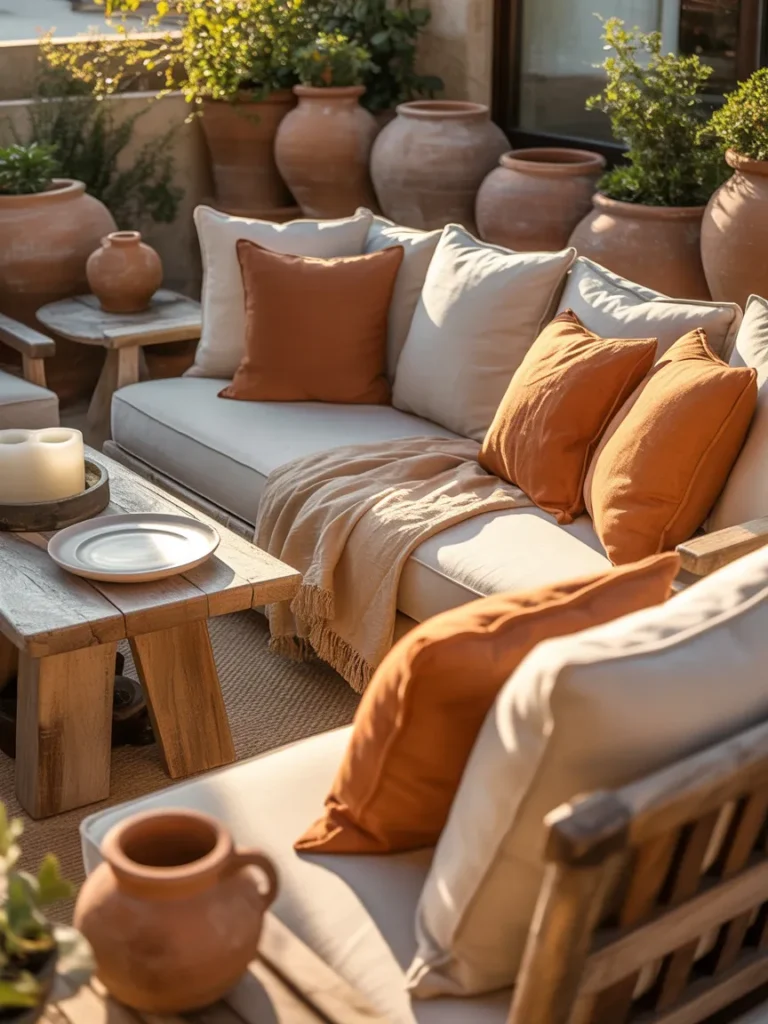
Vibe: Sun-warmed and approachable.
Why it works: Warm white as a base prevents visual heaviness on sunny patios, while terracotta echoes earth tones that naturally coordinate with any landscape. This palette works year-round—it’s never trendy enough to feel dated, never neutral enough to feel bland. Terracotta specifically grounds warm whites that might otherwise feel cold.
How to get it: Start with warm white as your dominant tone (60% of soft goods—cushions, throws, rugs). Layer terracotta through plants, planters, and accent pillows (30%). Add natural wood or taupe details (10%) to warm the white without overwhelming the palette. Avoid cool whites (those with gray undertones) which can look clinical next to warm terracotta.
Shop The Look
- Warm white outdoor cushion covers set of 4 sunbrella
- Terracotta ceramic planter set large grouping
- Natural linen throw pillow covers rust and cream tones
- Warm white area rug jute blend outdoor 6×9
- Natural wood outdoor side table teak or acacia
4.Intimate Loveseat & Ottoman for Two
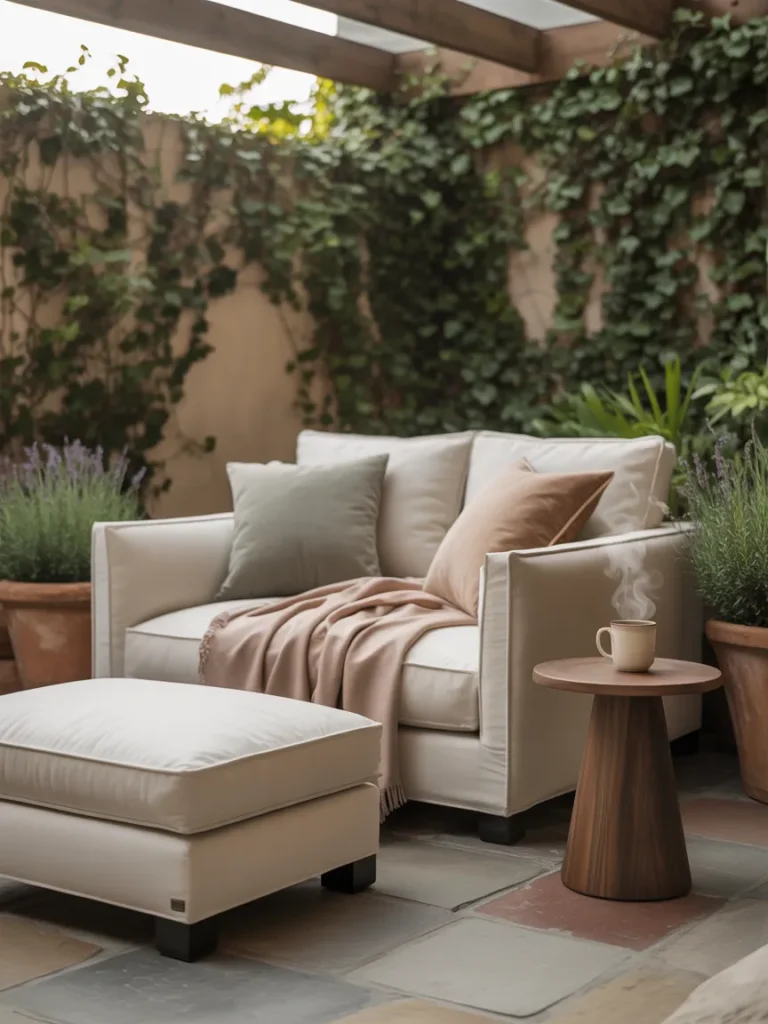
Vibe: Intimate and luxe.
Why it works: Not every outdoor space needs to accommodate eight people. A loveseat + ottoman setup is perfect for couples or small households, and it signals intentionality and self-care. The arrangement feels inherently romantic and relaxing rather than “making do with a small space.”
How to get it: Choose a loveseat with deep, comfortable cushions and a matching ottoman. Position them perpendicular to each other (loveseat facing outward toward a view, ottoman extending from one end). Add one small side table for drinks. This is one of the few outdoor layouts where less-is-more creates more impact than abundance.
💡 Quick Win: A loveseat + ottoman costs less than a full sectional but feels more intentional for smaller spaces—look for ones with removable cushion covers for easy cleaning.
5.Monochromatic Gray Palette
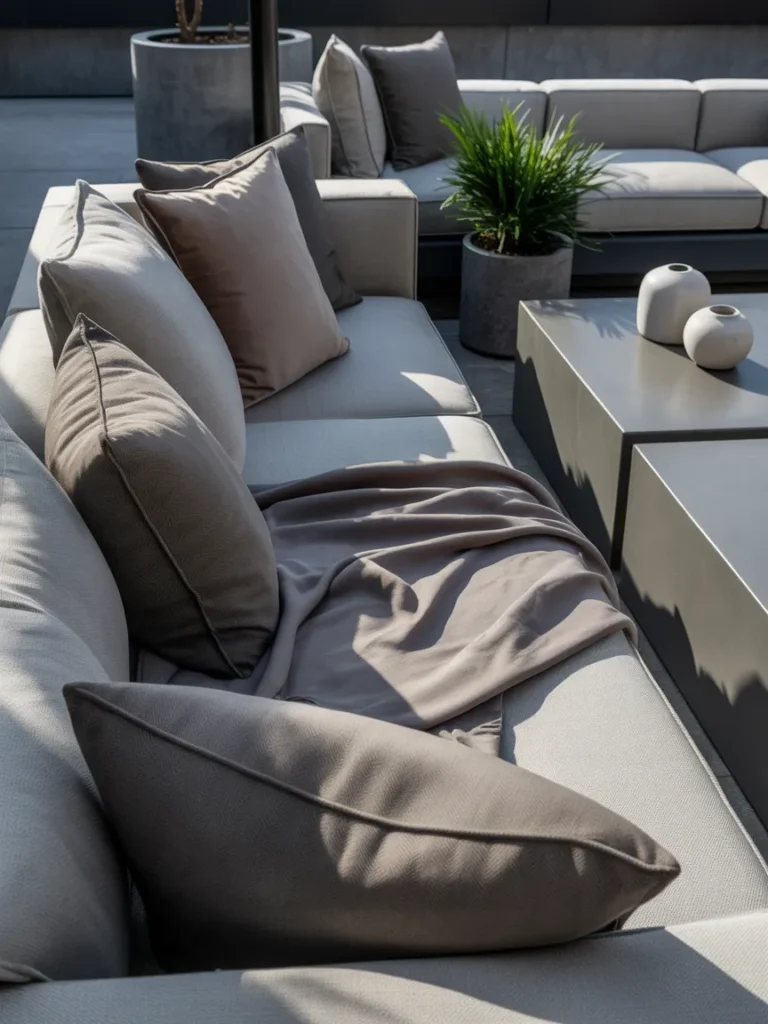
Vibe: Still and meditative.
Why it works: Monochromatic palettes read as intentional and high-design, even on a budget. Gray specifically feels modern and sophisticated while aging beautifully (it doesn’t yellow or fade like pure whites). Tonal variation within gray prevents boredom—dark gray pillows on light gray cushions create depth without color.
How to get it: Start with a neutral gray furniture base (sectional or sofa in warm or cool gray depending on your architectural undertones). Layer through pillows and textiles in 2-3 additional gray tones—one lighter, one darker. Add one potted green plant for life. Limit accent colors to white or soft greige only.
6.Wraparound Built-In Bench
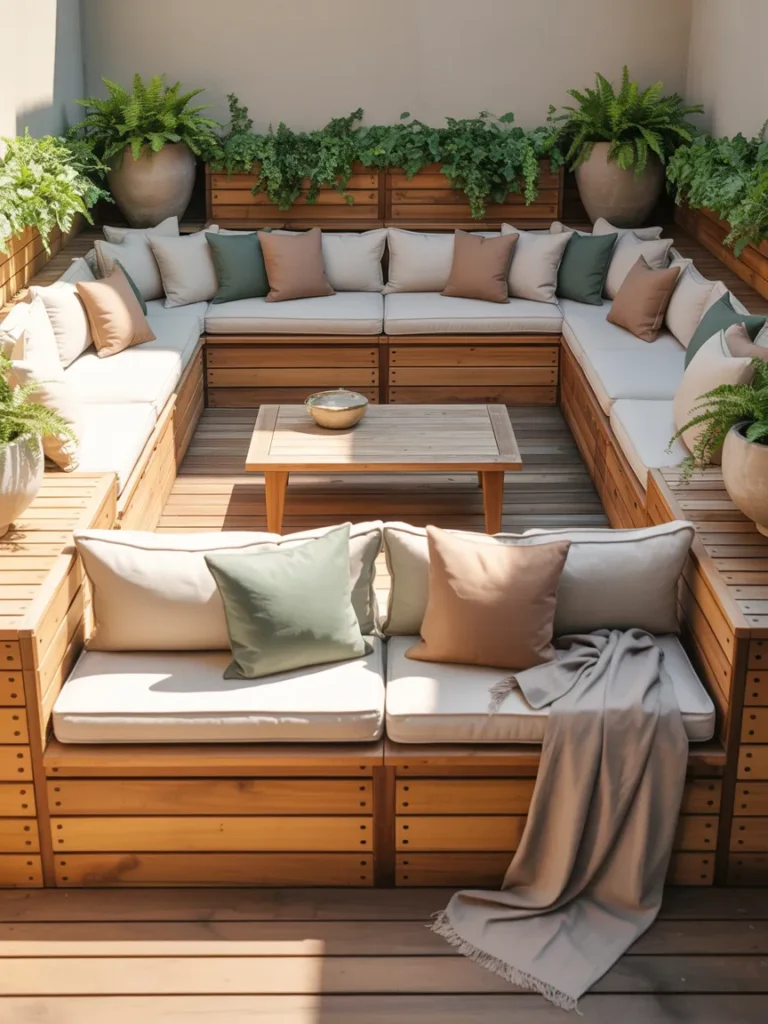
Vibe: Grounded and permanent.
Why it works: Built-in seating transforms a patio from temporary to intentional. A wraparound bench creates maximum seating efficiency while anchoring the entire layout—it becomes the architectural feature that defines the space. This approach works beautifully for patios with existing walls or fences, turning boundaries into assets.
How to get it: Measure wall lengths where you want seating. Commission a simple custom bench (or DIY with 2×12 lumber and concrete footings), or use modular bench components. Cushion depth should be 24-28 inches for comfort. Storage under the bench maximizes function. Layer throw pillows to define comfort zones within the longer seating surface.
💡 Quick Win: If custom building isn’t feasible, line your patio wall with individual outdoor benches (stackable, from outdoor furniture retailers) and top with coordinating cushions—creates the built-in effect at a fraction of the cost
7.Dual Zone Dining + Lounge Split
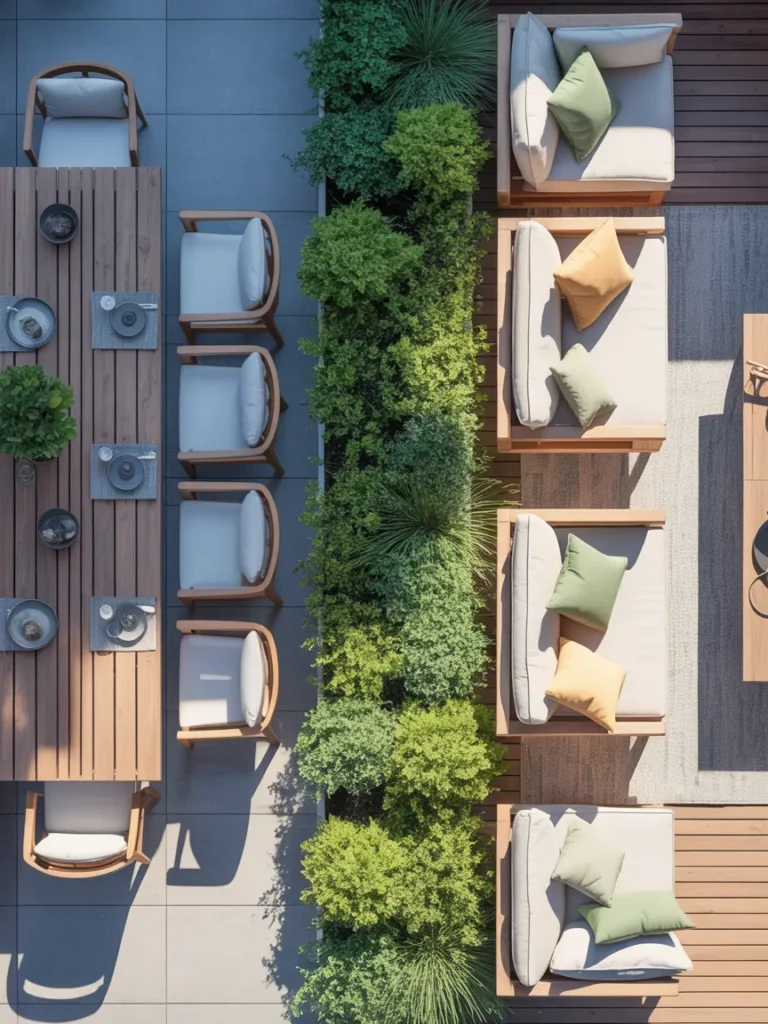
Vibe: Purposeful and expansive.
Why it works: Separating eating from lounging prevents the “crowded” feeling that happens when you cram both onto one patio. Each activity gets its own breathing room. The planter line or subtle level change acts as a psychological boundary without walls—guests intuitively understand they’re moving between two different functions.
How to get it: Use actual distance between zones—minimum 4 feet walkway. Use a row of tall planters (3-5 feet height) or a low raised bed to mark the divide without blocking sightlines. This creates what designers call “functional zoning”—people can see both areas but understand the spatial purpose.
Shop The Look
- Rectangular dining table outdoor teak or composite 4-person
- Dining chair set weathered finish stackable outdoor
- Low-back lounge chairs with sunbrella cushions set of 2
- Tall ceramic planter set white or soft gray
- Outdoor area rug jute natural fiber 5×
8. Floating Furniture Drift
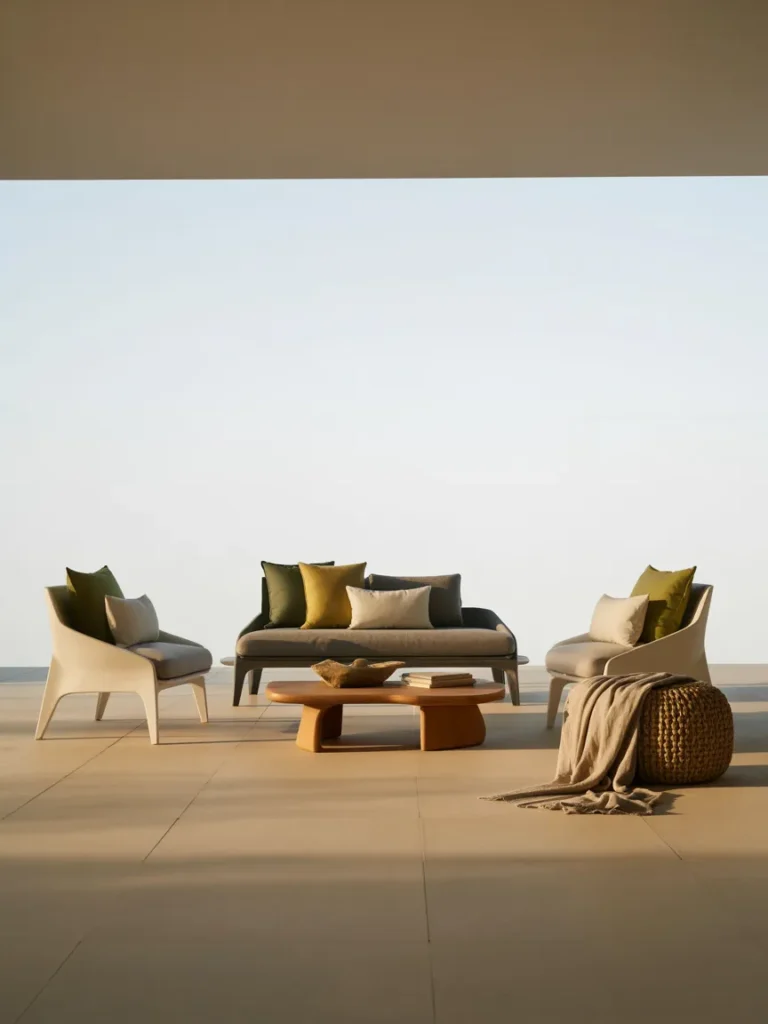
Vibe: Still and intentional.
Why it works: Floating furniture—rather than anchoring everything to the perimeter—creates a gathering point that feels like an actual room. The negative space becomes part of the design rather than wasted square footage. This approach works best on patios larger than 15×12 where you can afford to pull furniture 3-4 feet away from walls.
How to get it: Start with one anchor piece (sofa), then add 2-3 companion pieces that directly face it, creating a conversation pit. Keep pathways clear on at least two sides for movement. The math: if your patio is 20×16, leave 18 inches of clearance on at least one edge.
💡 Quick Win: Use a low platform or subtle area rug to visually “anchor” the floating arrangement and prevent it from feeling adrift.
9. L-Shaped Conversation Garden
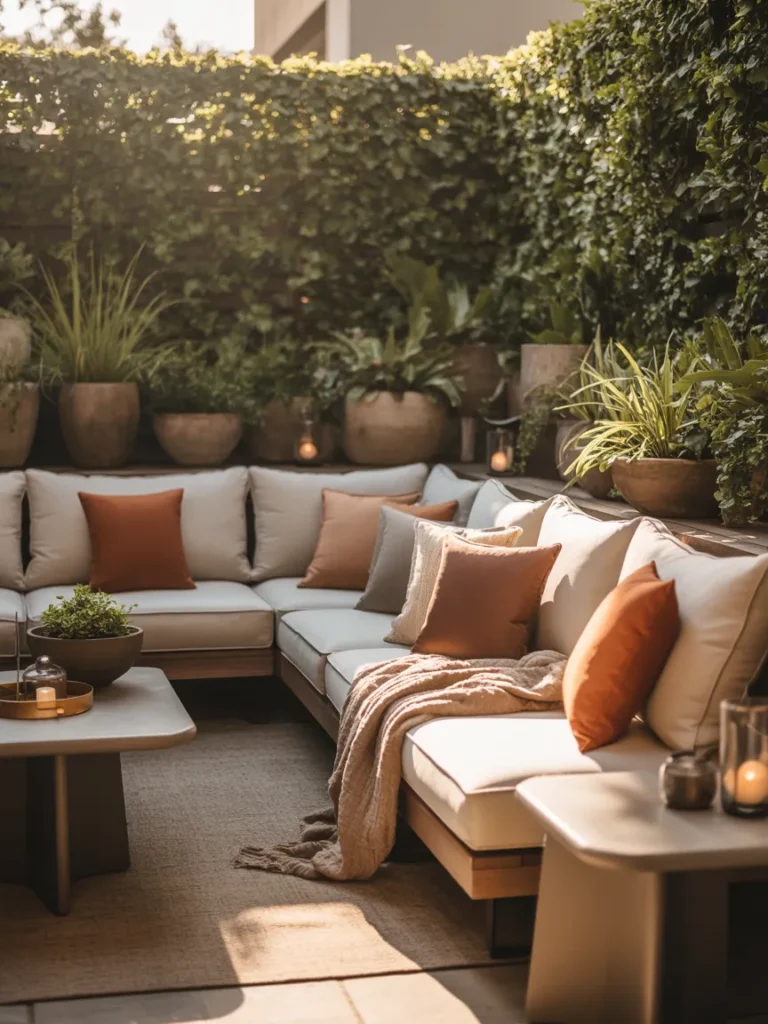
Vibe: Grounded and gathered.
Why it works: The L-shape naturally creates a contained conversation pod while maximizing seating capacity in one unified piece. By anchoring the sectional in a corner, you define the primary activity zone without blocking sightlines across the patio. This arrangement respects visual weight—the bulk of the furniture is concentrated, leaving the opposite end open for movement or dining.
How to get it: Measure your corner wall lengths first—most sectionals come in 2-piece or 3-piece configurations. Position the longer side along the wall that catches afternoon light, orient the shorter return to face outward toward your best view. This way, people lounging actually have something worth looking at.
Quick Win: If a full sectional isn’t in your budget, replicate this layout with two separate loveseats angled at 90 degrees—costs half the price, same sightline advantage.
10.Asymmetrical Seating Cluster
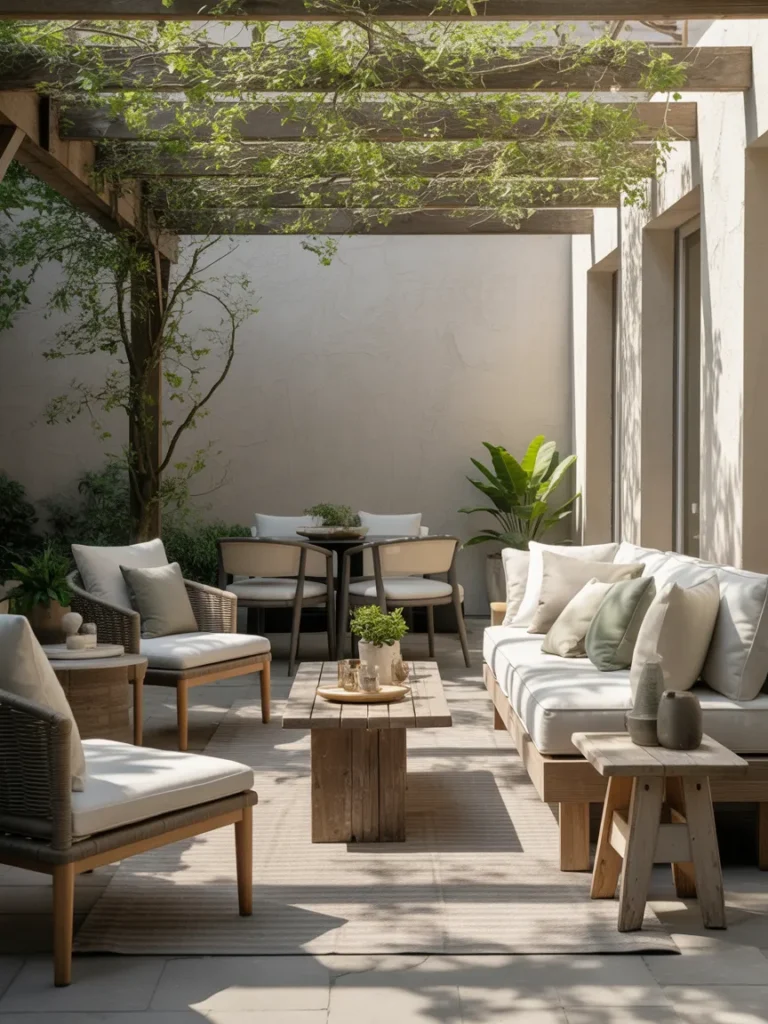
Vibe: Layered and natural.
Why it works: Asymmetry actually creates visual interest while maintaining functionality. By varying furniture heights (lounge at 20″, dining chairs at 18″, benches at 16″), you prevent that “matched set” flatness. People’s sightlines still connect—they can chat across the difference. This works especially well for patios with irregular shapes or multiple entry points.
How to get it: Map your patio as a rough grid. Place your tallest piece (usually lounge or sectional) as anchor. Add secondary pieces at slightly different heights that still allow conversation sightlines. Test by sitting in each piece—you should feel part of a cluster, not isolated.
Quick Win: Use throw pillows in varying sizes and proportions to create visual texture that reinforces intentional asymmetry (don’t match them perfectly).
11.Pergola-Anchored Dining Setup
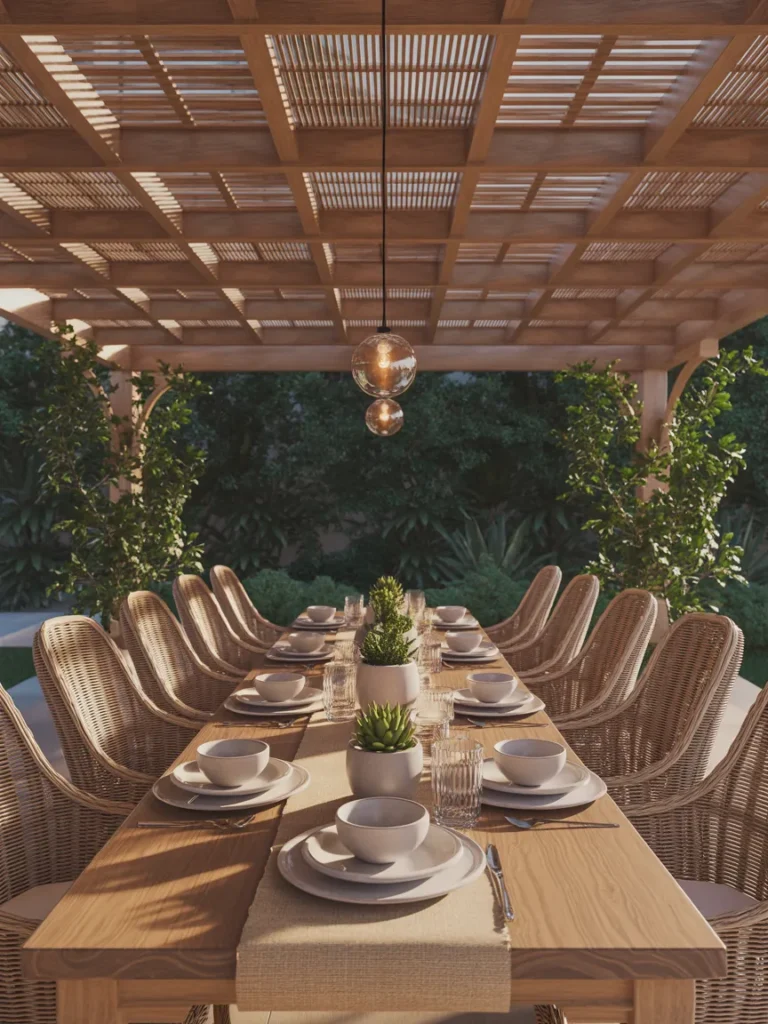
Vibe: Sheltered and purposeful.
Why it works: Overhead structure (pergola, shade sail, partially covered patio) transforms a dining arrangement from “eating outside” to “dining room that happens to be outside.” The shade signals permanence and intentionality. The defined area makes your patio feel like it has rooms—structure creates rooms, even outdoor ones.
How to get it: If you don’t have a pergola, add one (or a shade sail, or even a large outdoor umbrella positioned just right). Position dining table directly underneath so people feel the overhead benefit. Leave walking space on at least one side. This arrangement works especially well if your pergola connects to a lounge area 8-10 feet away.
12.Mixed Textures & Materials
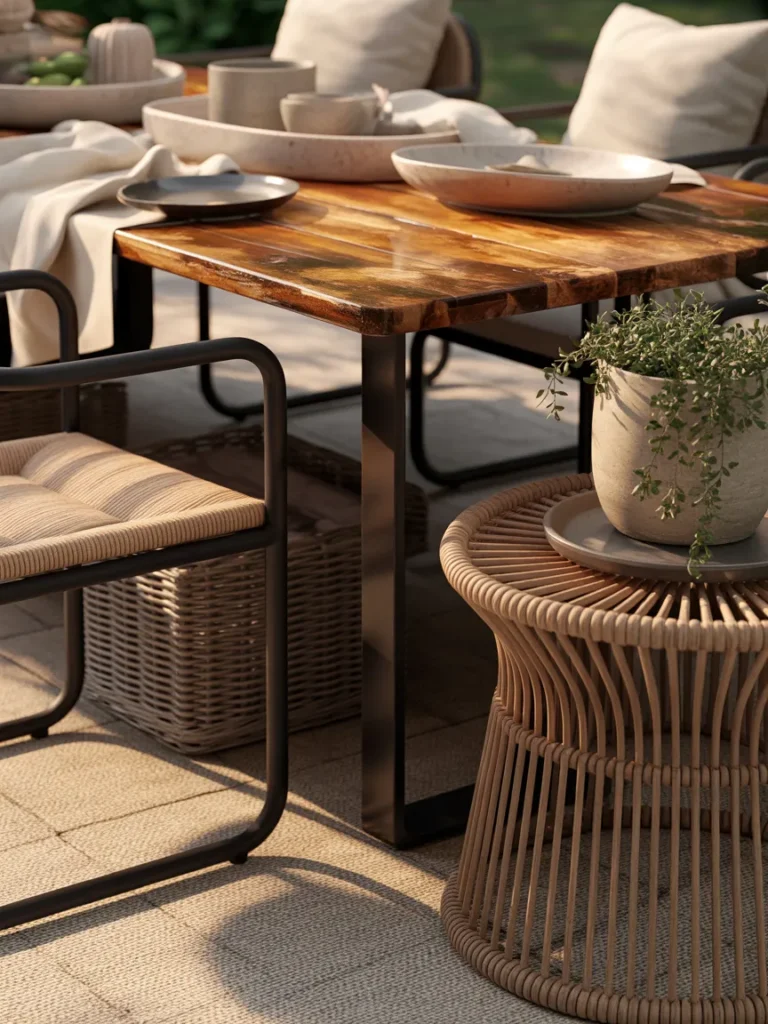
Vibe: Raw and collected.
Why it works: Mixing materials creates visual hierarchy and interest without looking chaotic when colors stay coordinated. Wood suggests permanence, metal adds edge, rattan brings warmth. Together, they create a “collected over time” feeling that’s more sophisticated than matching suites. Textures also diffuse light differently, which adds dimension to flat patios.
How to get it: Choose a color anchor first (warm whites or warm grays). Then layer materials: one dominant (maybe wood), one accent (maybe metal), one soft (rattan or woven). Aim for no more than three material types per space, or it tips into cluttered.
13. The Conversation Pit
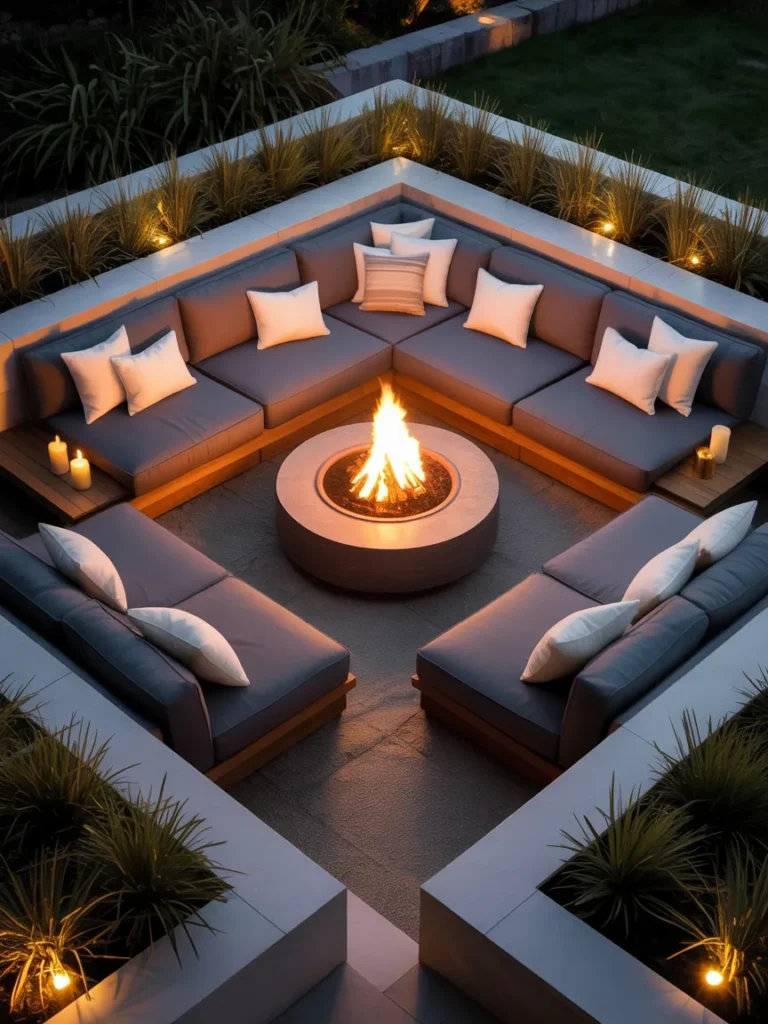
Vibe: Gathered and contained.
Why it works: The “pit” concept—whether literal or implied through arrangement—creates an inward-focused energy. Everyone naturally looks toward the center, facilitating conversation. It’s the design principle behind amphitheaters and fireside gatherings. On a practical level, it also gives a large patio clear organizing logic.
How to get it: On a standard patio, create this through arrangement and visual definition. Place a low central focal point (fire table, planter, low table). Arrange seating pieces in a circle or semi-circle facing inward. Optionally, line the perimeter with planters or define the area with a circular area rug. If your patio allows, an actual sunken seating area increases intimacy.
14. Elevated and Ground Level section
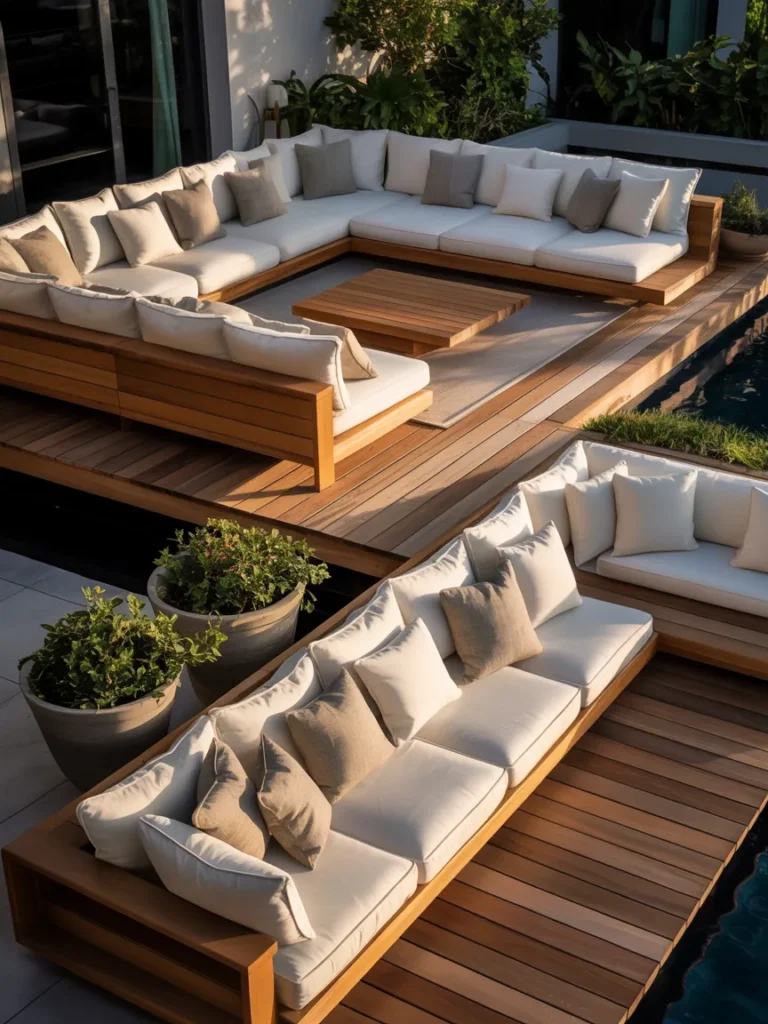
Vibe: Structured and layered.
Why it works: Different elevation levels create visual interest and define separate functional zones without needing walls. Raised platforms make seating feel more permanent and intentional. They also allow conversation across levels—someone lounging on the raised platform can chat with diners below without awkward angle. This layout solves for patios with existing level changes.
How to get it: If your patio has natural elevation changes, work with them rather than against them. Position lounging furniture on the raised area (naturally feels more expansive), dining or secondary seating on the lower level. Create a 6-12 inch step or gentle ramp between zones. This layout maximizes existing architecture.
15.Linear Single-Row Lounge
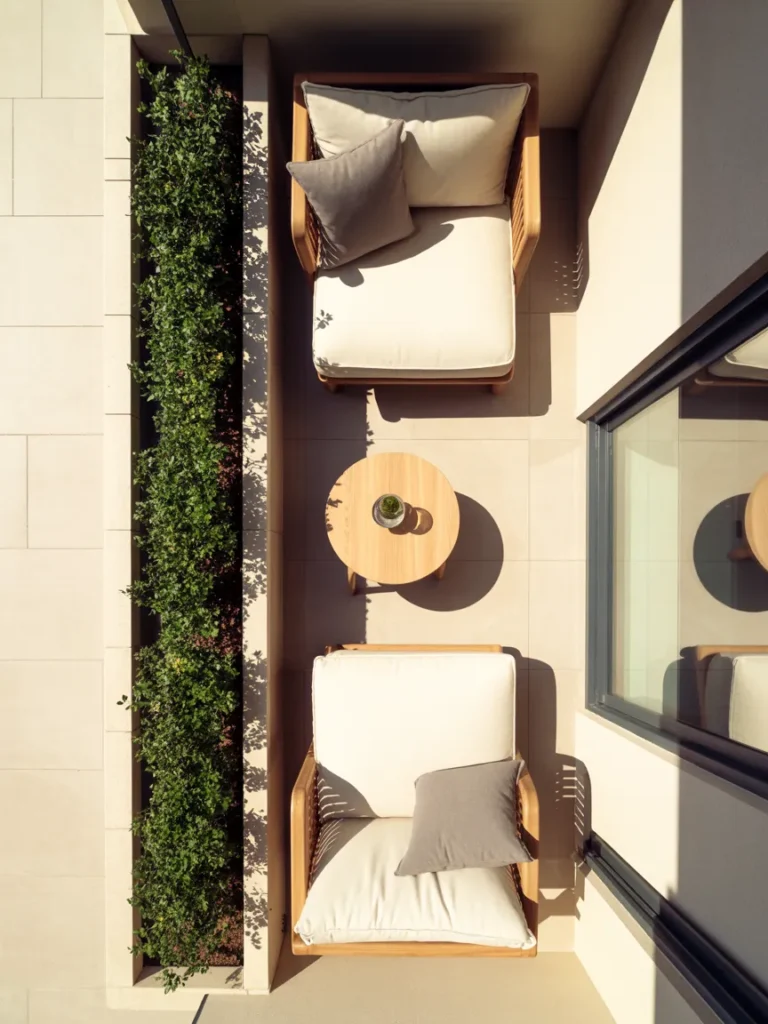
Vibe: Streamlined and zen.
Why it works: Long, narrow spaces seem constraining until you embrace the linearity. By arranging furniture lengthwise—not widthwise—you honor the patio’s actual proportions. Two lounge chairs placed end-to-end feel luxe in a narrow space, whereas a full sectional would feel cramped.
How to get it: Measure your patio length and width accurately first. If width is under 8 feet, arrange seating lengthwise. Use a single narrow side table (under 24 inches wide) between chairs. Keep depth minimal. This approach works beautifully for balconies, side yards, and narrow decks.
Quick Win: Position two lounge chairs foot-to-foot in a narrow space and add a single low table between them—instant two-person conversation area that fits tight spaces.
16. Warm Wood & White Palette
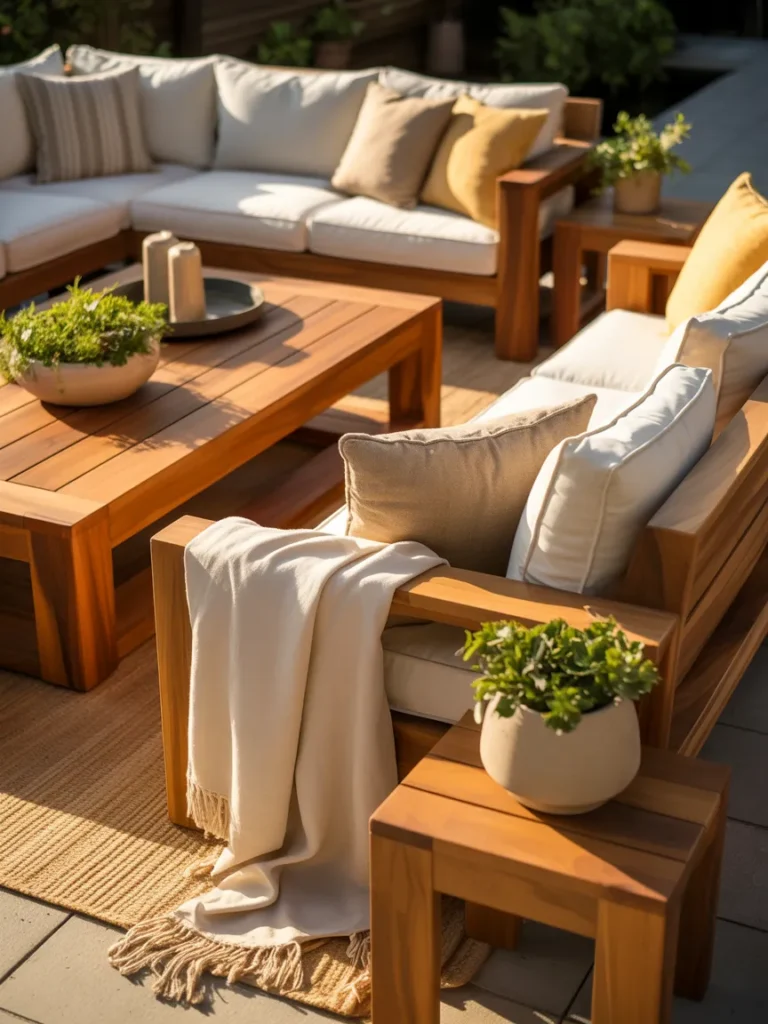
Vibe: Sun-warmed and grounded.
Why it works: Warm wood + warm white is universally flattering—it works with any landscape, any architecture. Warm wood brings richness and permanence. Warm white keeps it from feeling heavy. Together, they create a “natural but designed” aesthetic that never feels dated. This pairing also weathers beautifully—warm wood grays gracefully, warm white patinas gently.
How to get it: Choose your wood piece first (preferably teak, acacia, or cedar—woods that naturally weather well and contain oils). Layer warm white textiles (cushions, throws, outdoor rugs in warm white/cream). Add natural fiber accents (jute, linen, woven rattan). Avoid cool whites or gray wood tones in this palette—they’ll read as cold.
17. Clustered Planter Garden
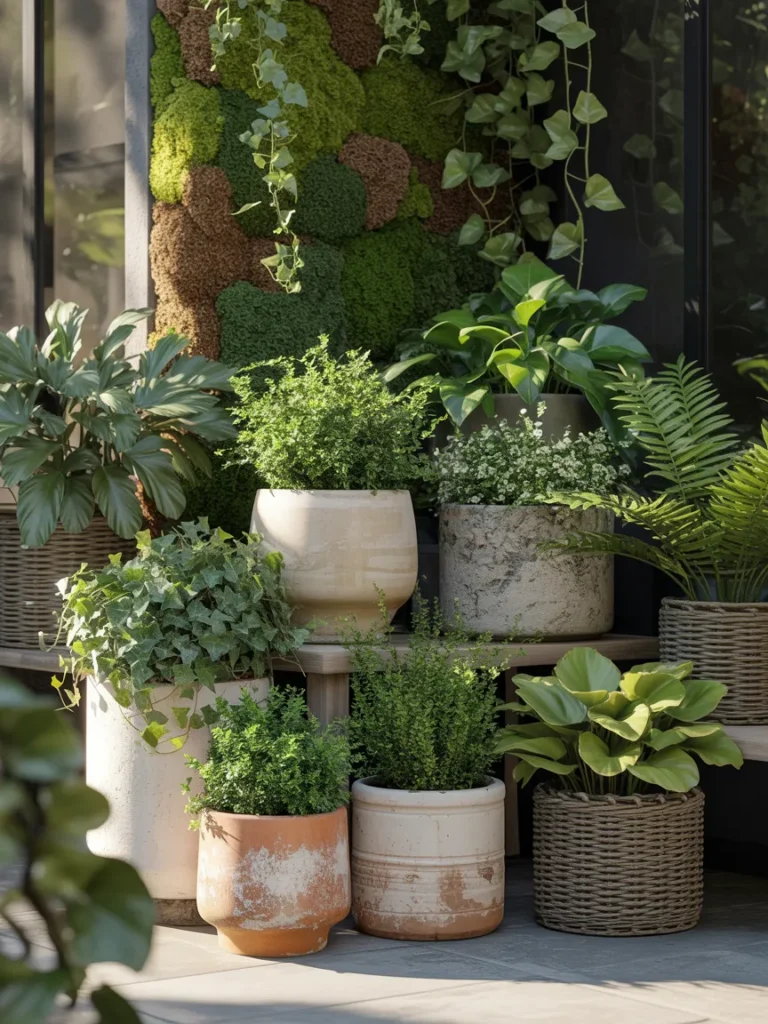
Vibe: Layered and alive.
Why it works: Vertical plantings in clusters create the impression of abundance without consuming precious seating square footage. Grouping planters (odd numbers, 3 or 5) at varied heights creates sophisticated visual hierarchy. The greenery softens hard patio surfaces and creates natural walls that define space without blocking views.
How to get it: Select 3-5 planters in coordinating styles (all ceramic, or all concrete, or a mix that shares a cohesive color). Vary heights by at least 12 inches between each planter. Group them in one corner or along one edge. Use tall, spiky plants (ornamental grass, dracaena) for height, trailing plants (ivy, pothos) for softness, and full green plants (ferns, hostas) for volume.
Quick Win: Buy 3 planters of the same color in S/M/L sizes and group them together—instant professional-looking arrangement that costs under $75.
18. Dual-Purpose Coffee Table
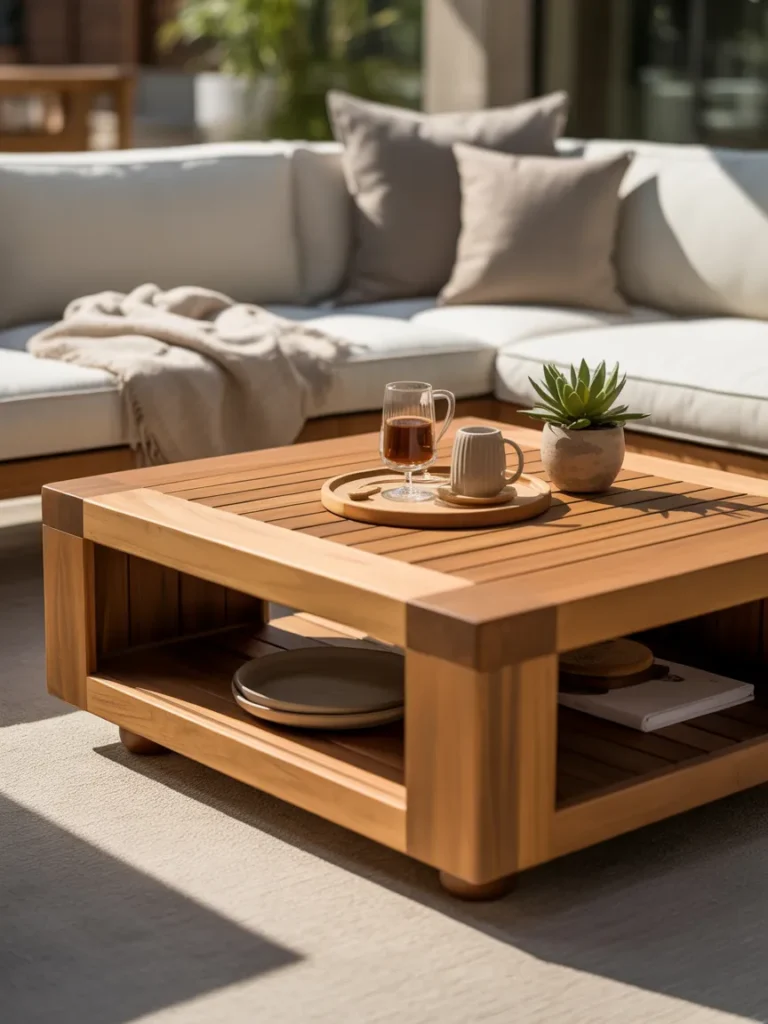
Vibe: Practical and luxe.
Why it works: In smaller outdoor spaces, furniture that serves two functions becomes essential. A low table that’s also seating height extends your usable footprint. It also creates flexibility—when entertaining more, that table becomes extra seating; when relaxing, it becomes a surface for drinks and books.
How to get it: Choose a table 16-18 inches high (ottoman-height), with a generous surface (minimum 30×30 inches). Look for natural wood or concrete finishes that hide wear. Ensure edges are smooth enough that using it as a foot rest or occasional seat feels intentional, not accidental. Style with a tray and throw pillow to signal its dual purpose.
19.Ambient & Task Lighting Layered Plan
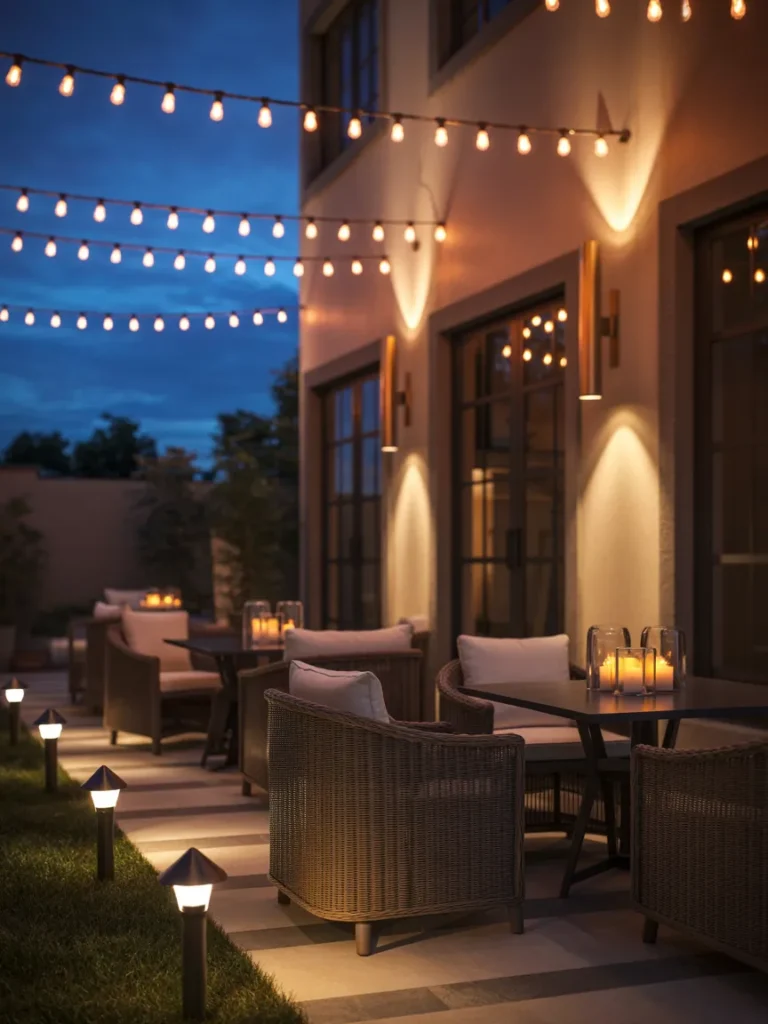
Vibe: Warm and layered.
Why it works: Outdoor spaces that only look good in daylight miss 50% of their potential. Layered lighting—ambient (general light), task (lights dining or work areas), and accent (atmospheric touches)—extends patio usability into evening and transforms the mood. Multiple light sources at different levels create visual interest and sophistication.
How to get it: Start with ambient overhead lighting (string lights, Edison bulb pendants, or soft flush fixtures). Add task lighting specifically over dining areas or reading nooks (wall sconces, directional fixtures). Add accent touches—small lanterns, solar ground lights, candles—that create depth and warmth. Aim for warm color temperature (2700K) across all sources for cohesion.
20.The Offset Balance
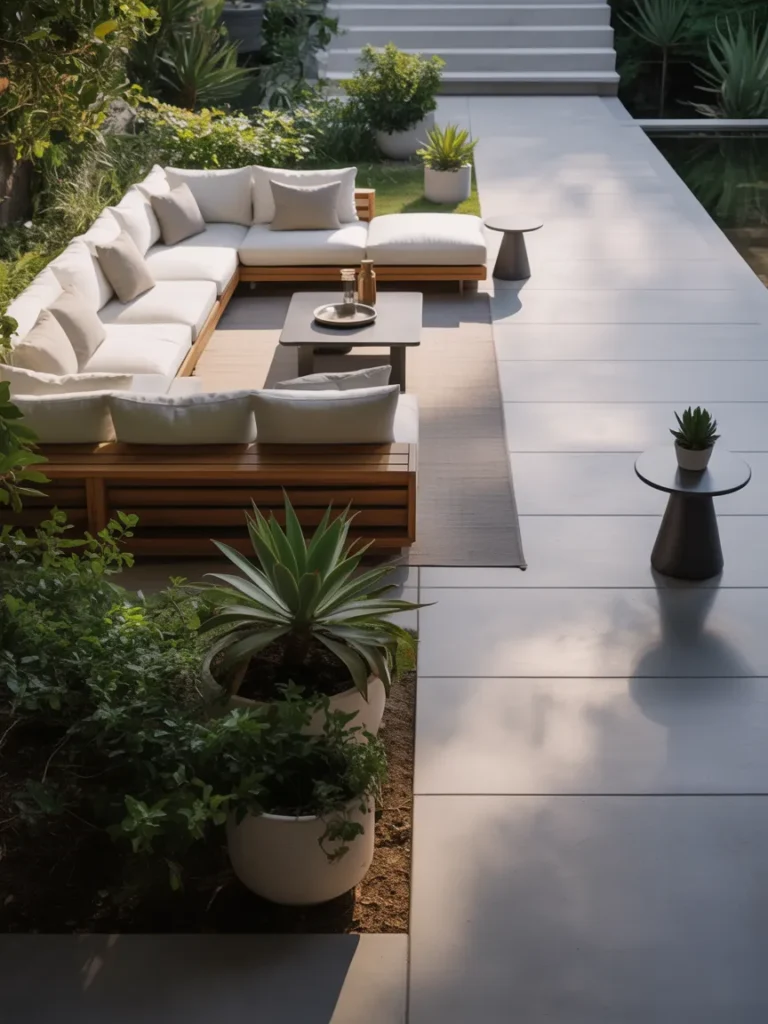
Vibe: Confident and flowing.
Why it works: Asymmetrical balance is more interesting than perfect symmetry, and it’s more practical for real patios. By anchoring furniture on one side, you preserve sightlines and movement through the space. This layout works especially well for patios where one direction has a view worth preserving (toward landscape, water feature, or door).
How to get it: Map your patio. Identify the best view or desired focal point. Place your primary seating facing that view, concentrated on one side. Leave the opposite or flowing side open for movement and visual breathing room. This creates dynamic balance—weight on one side, emptiness on the other, both intentional.
21.The Modular Seating System
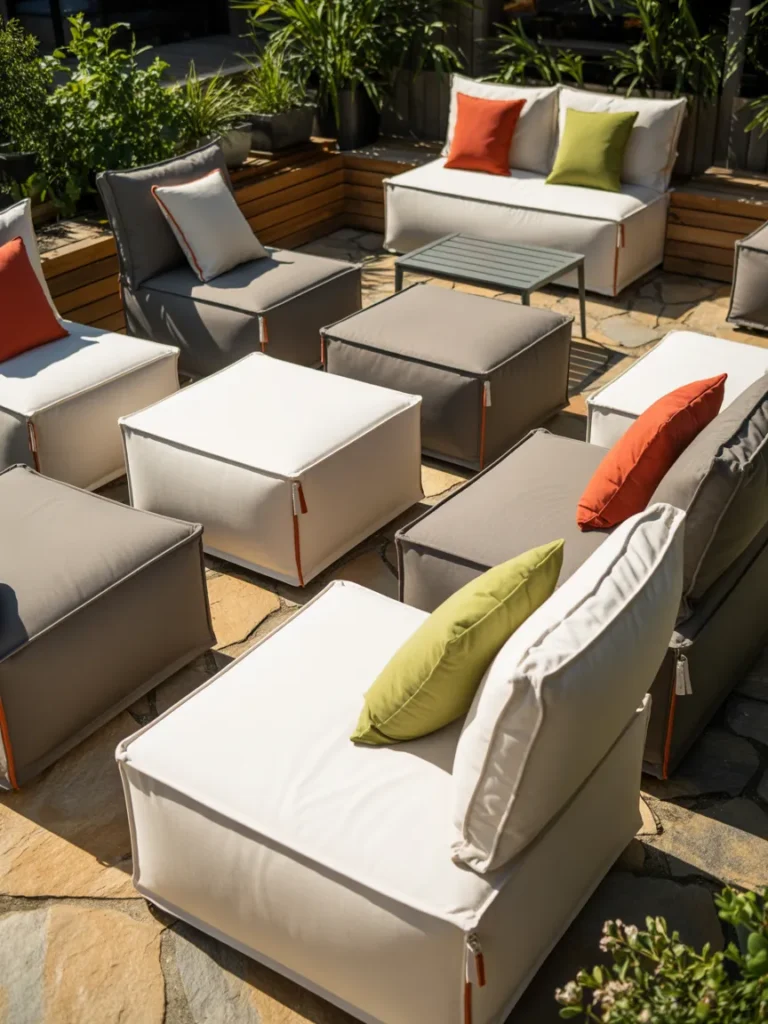
Vibe: Flexible and modern.
Why it works: Modular furniture acknowledges that your needs change—sometimes you need more seating for entertaining, sometimes you want an open space for yoga or play. Modular systems let you rearrange without buying new pieces. They also feel more affordable per-piece and less commitment-heavy than a full sectional.
How to get it: Look for modular systems where components are sold separately (from brands like Outer, Room & Board, Article). Start with a base configuration (2-3 pieces). Add pieces gradually as needs and budget allow. Choose a color or cushion style that coordinates across all pieces, even if you buy them over time.
Quick Win: Individual outdoor chairs + ottomans are cheaper per-piece than a sectional and more flexible—buy three matching chairs and one ottoman, rearrange as needed.
22.Fire Feature as Focal Anchor
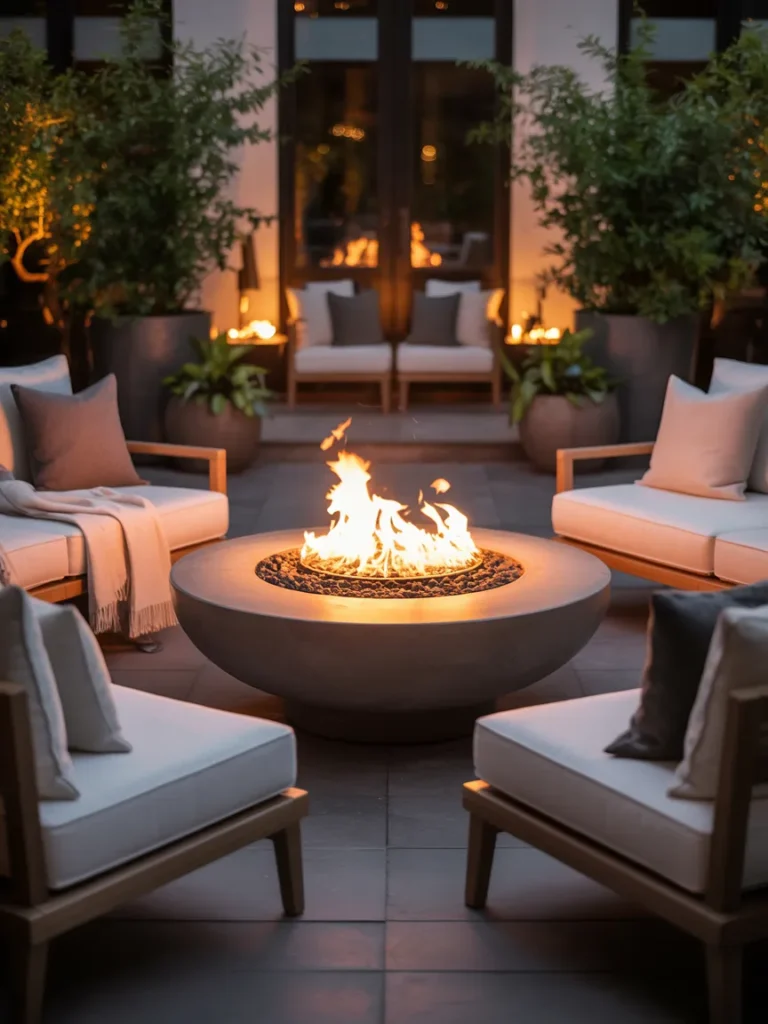
Vibe: Warm and gathered.
Why it works: Fire commands attention naturally. It creates a focal point on any patio, draws people together, and extends usability into cooler months. Seating arranged around a fire feature is inherently social and intimate. Even a small tabletop fire feature creates significant impact.
How to get it: Choose a fire feature appropriate to your space—a wood-burning pit for larger patios, a propane fire table for standard decks, or a tabletop feature for compact spaces. Arrange seating in a semi-circle facing it (minimum 4-5 feet distance for safety). Include a low side table for drinks and comfort items (blankets, etc.). Check local codes for setbacks and safety zones.
23.Color-Block Accent Wall
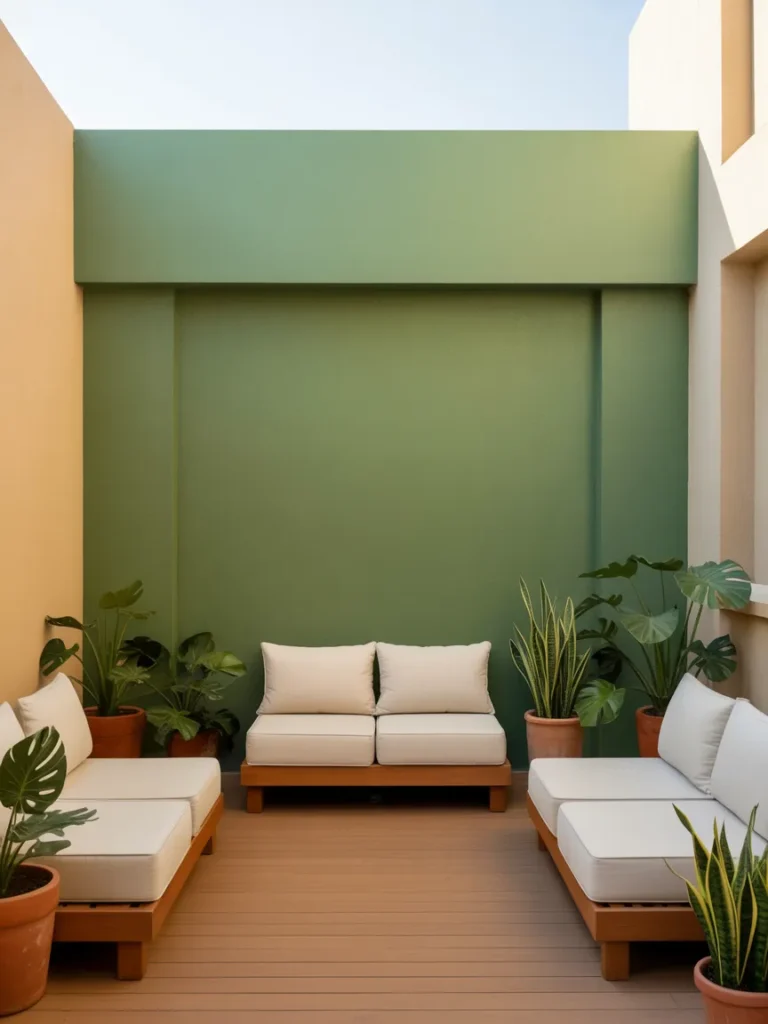
Vibe: Grounded and intentional.
Why it works: A color-blocked or planted accent wall immediately elevates a patio’s perceived design level. It gives the eye a focal point, defines the space, and makes the patio feel designed (not just “furnished”). A warm color (terracotta, sage) or green living wall specifically feels sophisticated and organic.
How to get it: Paint one wall an accent color from the warm/earthy palette (warm taupe, dusty sage, warm terracotta), or create a vertical garden wall with mounted planters. Position seating to face the wall, making it a visual anchor. Keep other surfaces neutral so the accent wall remains the hero.
Shop The Look
- Exterior paint gallon warm accent color terracotta or sage
- Vertical planter system wall-mounted living wall alternative
- Potted plants for living wall tall green varieties
- Seating upholstered coordinating with accent wall color
- Neutral throw pillows warm white to let accent wall shine
24.The Staggered Heights Silhouette
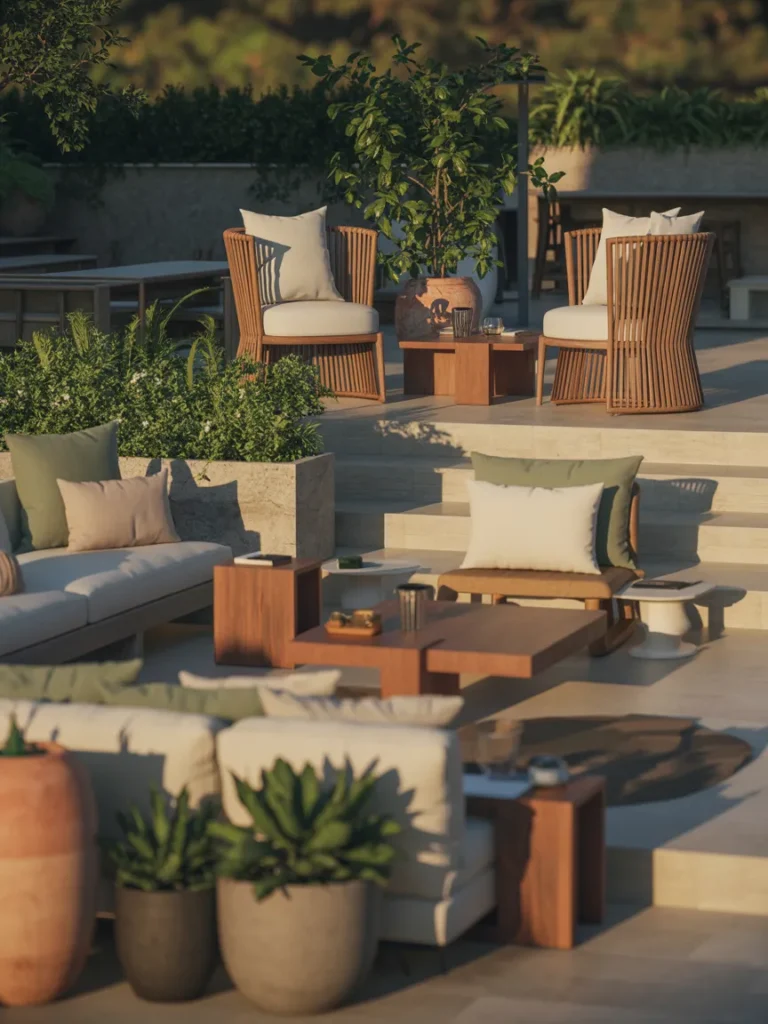
Vibe: Layered and intentional.
Why it works: When every piece of furniture sits at the same height, the patio feels flat and unfinished. Intentionally varying heights (lounges at 20″, dining chairs at 18″, benches at 16″) creates visual rhythm and sophistication. The staggered silhouette also helps a space feel larger because the eye moves through multiple visual planes.
How to get it: Map your seating pieces by actual height (get measurements from product specs). Select pieces that range across at least 4-6 inches of variation. Arrange them so sightlines stay connected (low piece doesn’t block high piece). Add planters and potted plants at varied heights to reinforce the staggered profile.
25. Zoned Entertaining + Quiet Retreat
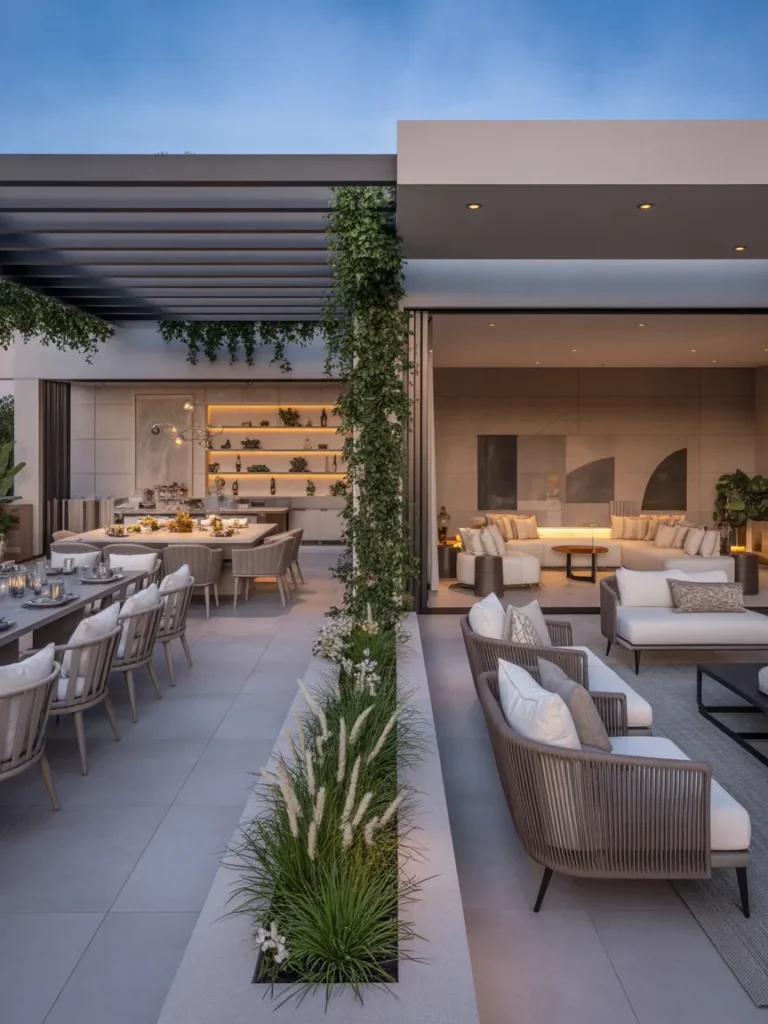
Vibe: Sophisticated and flexible.
Why it works: One patio serving two purposes requires intentional layout. Clear zones prevent the “crowded everywhere” feeling when entertaining, while preserving a quiet retreat space. The subtle separation (pergola, planter, level change) allows function to differentiate visually without creating walls.
How to get it: Measure your patio. Mentally divide into two approximately equal spaces. Assign one for entertaining (dining + multiple seating), one for retreat (lounge or intimate seating). Create a transitional element between zones using a low pergola section, raised planter bed, or subtle shift in pavers. Ensure each zone has its own side table / lighting strategy.
Shop The Look
- Dining table for entertaining zone 6-person capacity outdoor
- Dining chair set for entertaining zone 6 pieces
- Lounge chair retreat zone single piece comfortable
- Pergola section transitional element light shade structure
- Tall planter bed or raised garden border zone definition
Ready to Create Your Dream Outdoor Patio Furniture Layout?
The 25 layout ideas you’ve explored span colors, materials, lighting, furniture arrangement, and solutions for every space size—from intimate balconies to sprawling decks. Each approach prioritizes a different design principle, giving you frameworks to adapt to your actual patio, not template layouts forcing your space into misfit boxes.
Start small, and lean into that starting point with confidence: measure your patio, identify one primary function, and arrange furniture to honor that function. Transformation doesn’t require demolition—it requires intention. A shifted loveseat, a reoriented table, a single well-chosen throw pillow anchoring a color story—these small shifts create the sense of “someone designed this” that makes people want to stay outside.
Today’s action: grab a measuring tape and sketch your patio layout (even rough, to scale). Take a photo of your current arrangement. That visual documentation is your baseline—the before-picture that proves your choices mattered. When you return to your patio after implementing one small change, you’ll feel the difference immediately.
An intentional patio layout isn’t luxury—it’s an investment in how you actually live in your home. The best outdoor furniture arrangement is the one that draws you out the door at 5 p.m. on a Tuesday, that makes you linger with coffee in the morning, that transforms a concrete slab into a room you want to be in. That’s what these 25 ideas are built to create. Pin your favorites, revisit them, and build your outdoor room one thoughtful choice at a time