
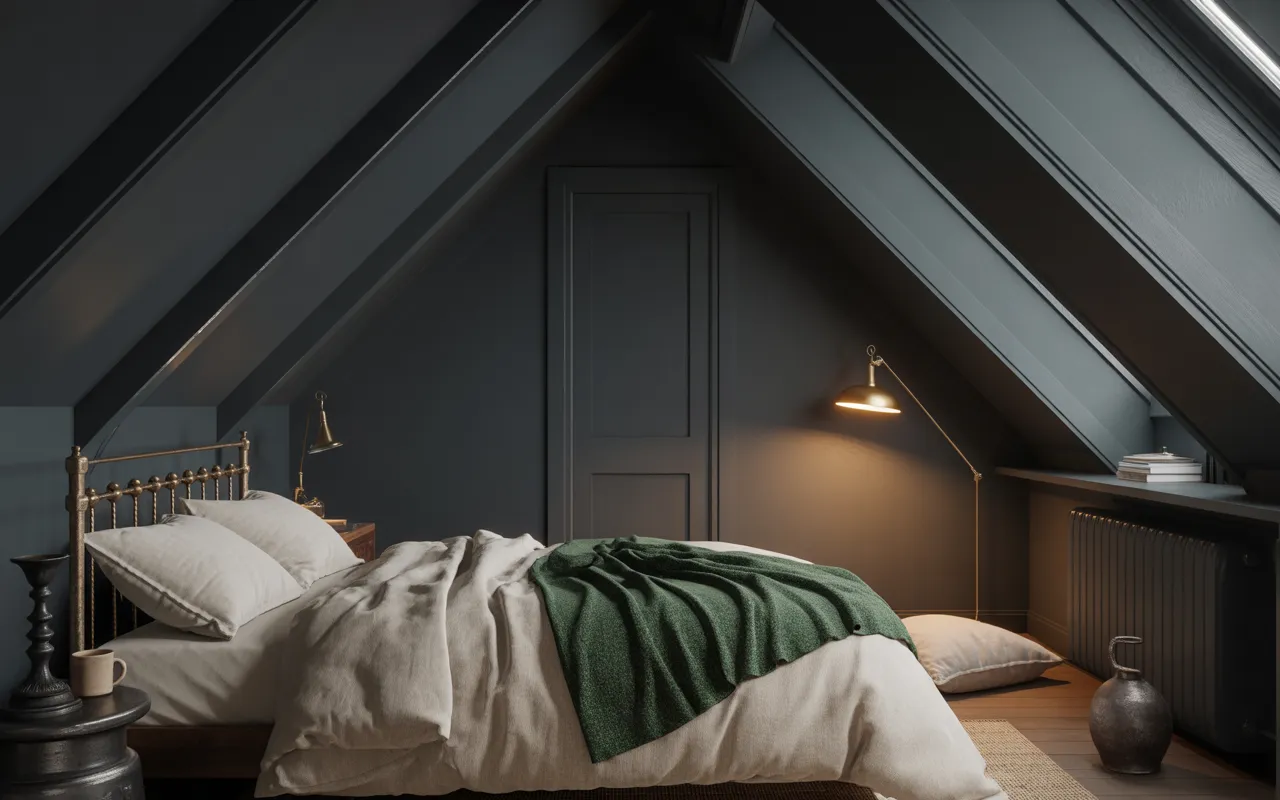
17 Attic Bedroom Ideas for a Dreamy Retreat
A dreamy attic bedroom transforms an overlooked storage space into a cozy sanctuary defined by sloped ceilings, warm textures, and intimate scale. This article delivers 17 distinct attic bedroom ideas, from moody color drenching to minimalist Japandi layouts, each designed to solve the unique challenges of awkward angles and limited square footage.
Morning light filters through a small dormer window, pooling on wide-plank floors worn smooth by time. The ceiling slopes low on one side, forcing a gentle intimacy, like being tucked inside a soft envelope. The air smells of linen and old wood, and the only sound is rain on the roof. Here are 17 ideas worth saving — and stealing.
Why Attic Bedroom Style Works So Well
The attic bedroom archetype draws from centuries of European garrets and American farmhouse sleeping porches — spaces never meant to impress but to shelter. Unlike a primary suite designed for show, the attic asks for honesty: exposed beams, imperfect plaster, floors that creak. Its distinct charm lies in limitation. Where other rooms fight for openness, the attic celebrates enclosure, making it the ultimate retreat for deep rest.
Core materials lean heavily into raw tactility: unfinished oak beams, lime-washed brick, wide-plank pine flooring, and natural linen. The color palette stays grounded in warm whites (Benjamin Moore’s White Dove), dusty taupes, deep charcoals, and muted ochre. These tones absorb light rather than reflect it, which softens the hard edges of dormers and kneewalls. The result is a palette that feels less decorated and more inherited.
Pinterest searches for “cozy attic bedroom” rose 210% year-over-year, driven by a post-pandemic hunger for “nested” spaces — rooms that feel like a deliberate retreat from open-plan everything. People are abandoning cavernous ceilings for the psychological safety of a low, contained room. The attic bedroom satisfies the same need as a weighted blanket: pressure, warmth, and boundary.
Small attics absolutely achieve this style, but only if you lead with light and subtraction. Prioritize a single hero element — a dormer reading nook, a sculptural bed frame, or a skylight — and edit everything else. In a tight attic, you cannot layer every trend. Choose one: texture OR color OR pattern. Never all three.
Style at a Glance
| Element | Core Trait 1 | Core Trait 2 |
|---|---|---|
| Philosophy | Enclosure over openness | Softness over sharpness |
| Materials | Raw wood, linen, wool, limewash | Unfinished brass, stone, cotton canvas |
| Color palette | Warm whites, dusty taupes, deep charcoals | Muted ochre, slate blue, cream |
1. Drench In Shadow
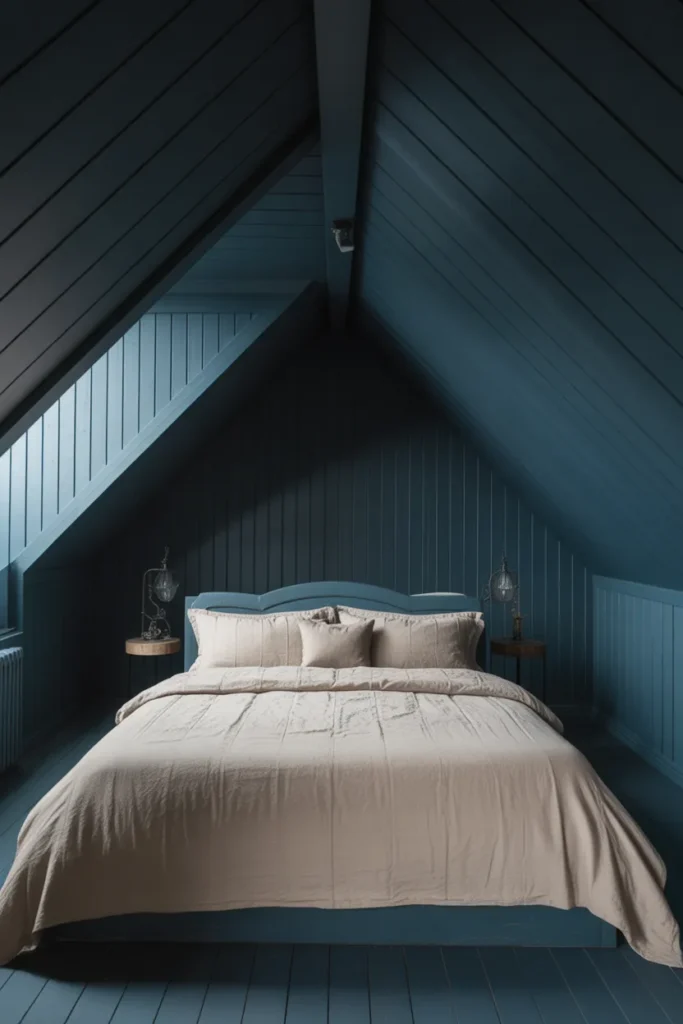
Vibe: Deep, still, enveloping
Why it works: Color drenching erases the visual clutter of trim and ceiling lines. On a sloped attic, this technique makes the architecture recede so the room feels larger, not smaller. The eye rests.
How to get it: Choose one flat-matte paint color (try Farrow & Ball’s “Down Pipe”) and paint every surface: walls, ceiling, baseboards, window casing, and door. Use the same sheen everywhere.
Shop The Look
| Product | Category |
|---|---|
| Charcoal matte flat latex paint | Paint |
| Cream linen duvet cover set | Bedding |
| Wrought iron wall sconce with switch | Lighting |
| Blackened iron candlestick holder set | Decor |
| Heavy cream cotton jersey sheets | Bedding |
2. Beam Contrast Play
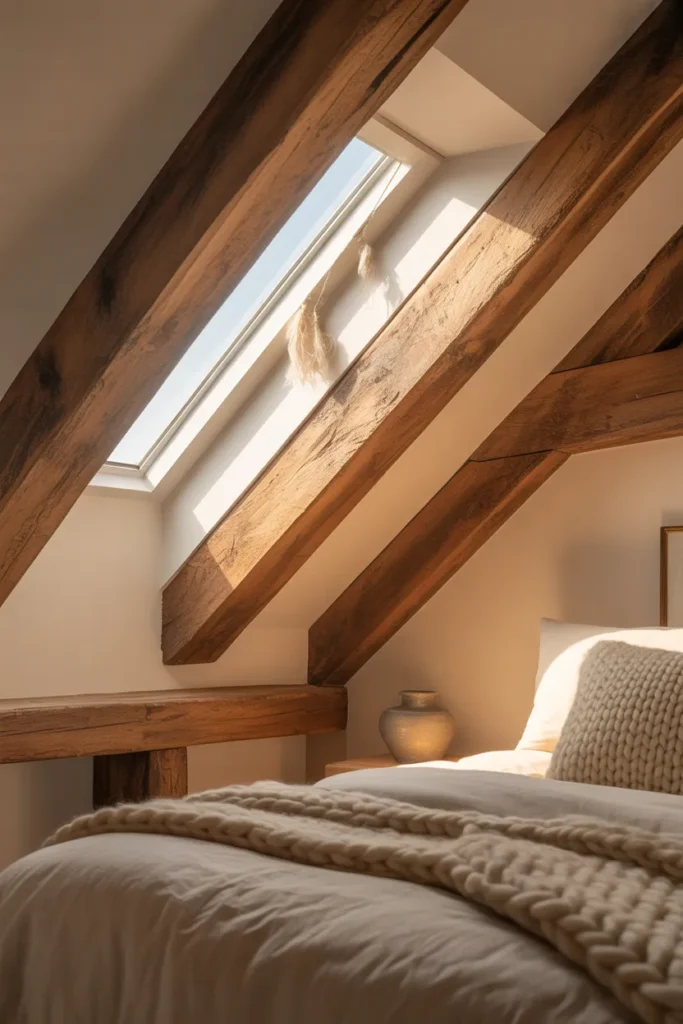
Vibe: Warm, grounded, structural
Why it works: The contrast between matte white surfaces and raw timber warms the room without adding color. Unstained beams bring organic texture that painted beams lose.
How to get it: Paint your ceiling and walls Benjamin Moore “Simply White” but leave every structural beam completely bare. Lightly sand off old stain or sealant. No polyurethane.
Shop The Look
| Product | Category |
|---|---|
| Warm white eggshell paint | Paint |
| Chunky knit wool throw blanket | Textile |
| Handmade ceramic bud vase | Decor |
| Natural flax linen duvet cover | Bedding |
| Unfinished oak floating shelf | Storage |
3. Skylight Reading Nook
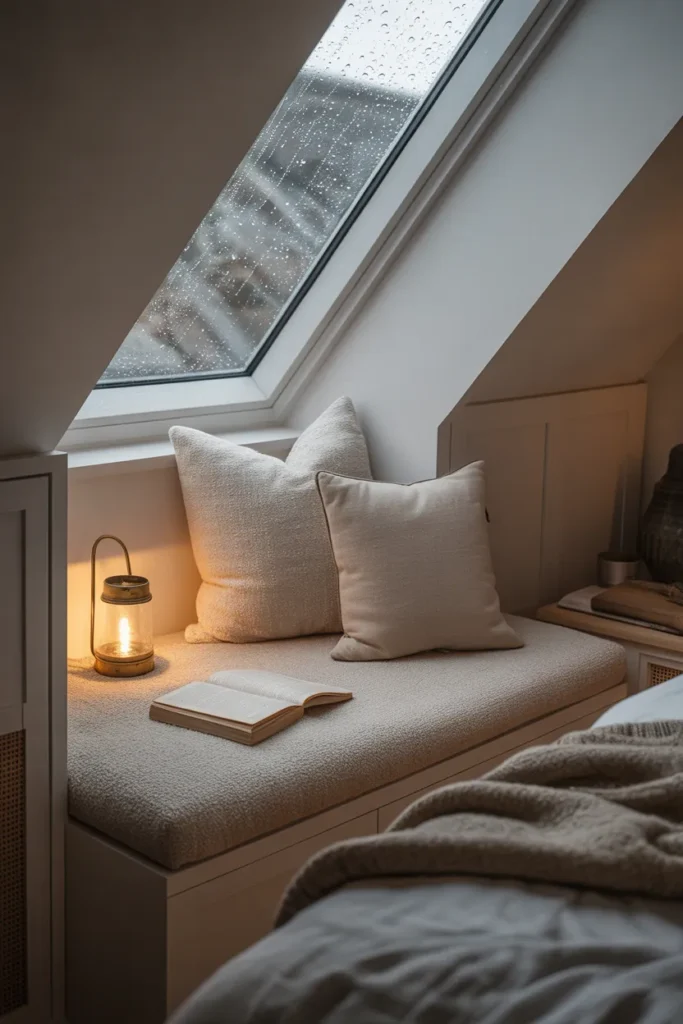
Vibe: Luminous, suspended, quiet
Why it works: Locating a seating zone directly under a skylight captures the most dramatic light shift — from bright noon to soft dusk — making a small nook feel like an observatory.
How to get it: Build or buy a low bench (18 inches high) that fits exactly under your fixed skylight. Add a 5-inch custom cushion. Do not add a backrest; let the sloped ceiling be the back.
Also SEE: 17 Conservatory Ideas for a Stylish and Serene Retreat
💡 Quick Win: Use a peel-and-stick Velcro strip to hang a battery-operated brass sconce on the sloped wall where drilling is impossible.
Shop The Look
| Product | Category |
|---|---|
| Cream bouclé bench cushion | Seating |
| Brushed brass battery sconce | Lighting |
| Linen pillow cover set (undyed) | Textile |
| Wool throw blanket charcoal | Textile |
| Small brass cup hook | Hardware |
4. Low-Frame Platform Bed
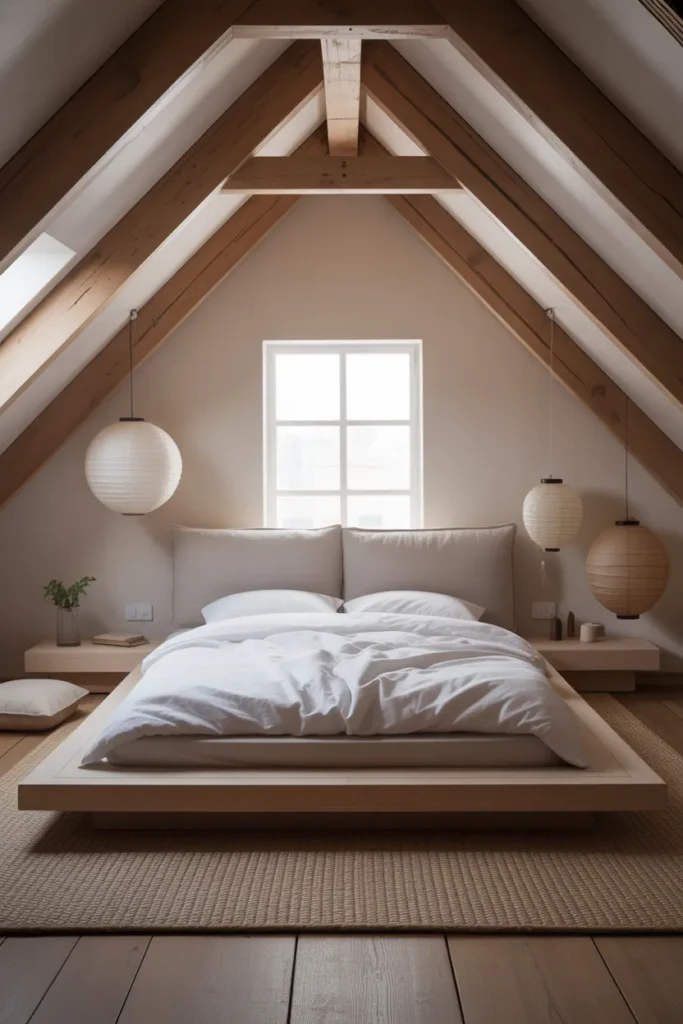
Vibe: Horizontal, grounded, expansive
Why it works: A very low bed frame visually lowers the room’s center of gravity, which makes a sloped ceiling feel intentional rather than oppressive. The horizontal line calms the eye.
How to get it: Use a solid wood platform bed with no box spring. Maximum height 8 inches from floor. Push the head of the bed under the lowest part of the slope, not the highest.
Shop The Look
| Product | Category |
|---|---|
| Low profile solid oak platform bed | Furniture |
| Japanese paper lantern pendant | Lighting |
| White cotton jersey sheet set | Bedding |
| Natural floor cushion round | Seating |
| Rice paper shade floor lamp | Lighting |
5. One Wall Of Warm Wood
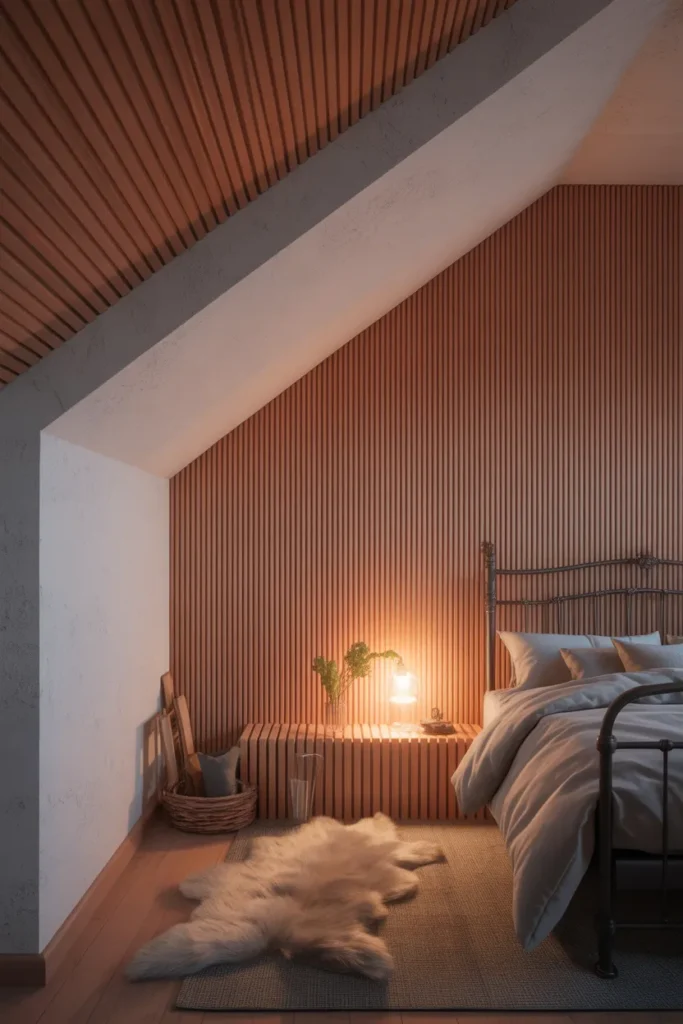
Vibe: Enveloping, tactile, cabin-like
Why it works: One textured wall anchors the entire room without closing it in. The unfinished cedar adds smell and tactility while the white wall reflects light back.
How to get it: Clad only the short wall or kneewall — never all walls. Use 4-inch tongue-and-groove boards. Leave raw or seal with clear matte finish only. No stain.
Shop The Look
| Product | Category |
|---|---|
| Tongue and groove cedar planks | Wall covering |
| Wrought iron full bed frame | Furniture |
| Sheepskin rug (natural cream) | Textile |
| Small potted snake plant | Decor |
| Matte clear wood sealer | Supplies |
6. Monochrome Linen Layers
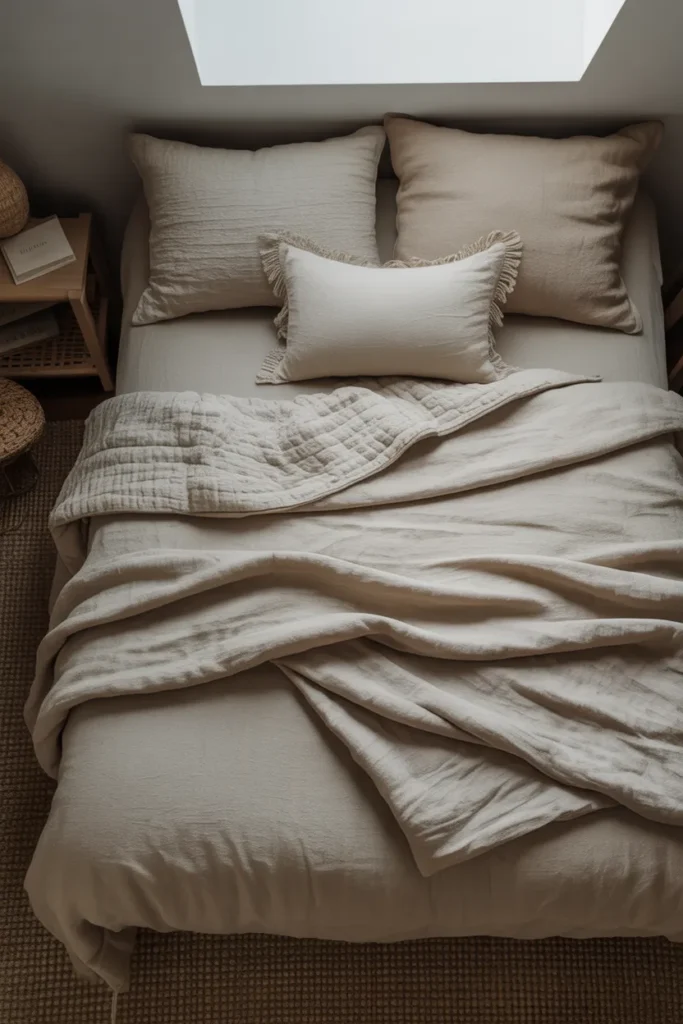
Vibe: Soft, hushed, breathable
Why it works: Layering identical colors in different weights and weaves creates depth without contrast. The eye reads it as rich but never busy — essential for small attics.
How to get it: Buy three separate linen pieces: a heavy duvet cover, a medium flat sheet, and a lightweight quilted coverlet. All in “natural” or “undyed oatmeal.” Use all three on the bed at once.
💡 Quick Win: Iron nothing. Linen’s beauty is its wrinkles. Wash on cold and tumble dry low, then pull from dryer slightly damp and spread directly on the bed.
Shop The Look
| Product | Category |
|---|---|
| Undyed linen duvet cover | Bedding |
| Lightweight linen quilted coverlet | Bedding |
| Oatmeal linen flat sheet | Bedding |
| Woven cotton fringe rug | Textile |
| Frayed edge linen pillow | Decor |
7. Dark Ochre Accent Dormer
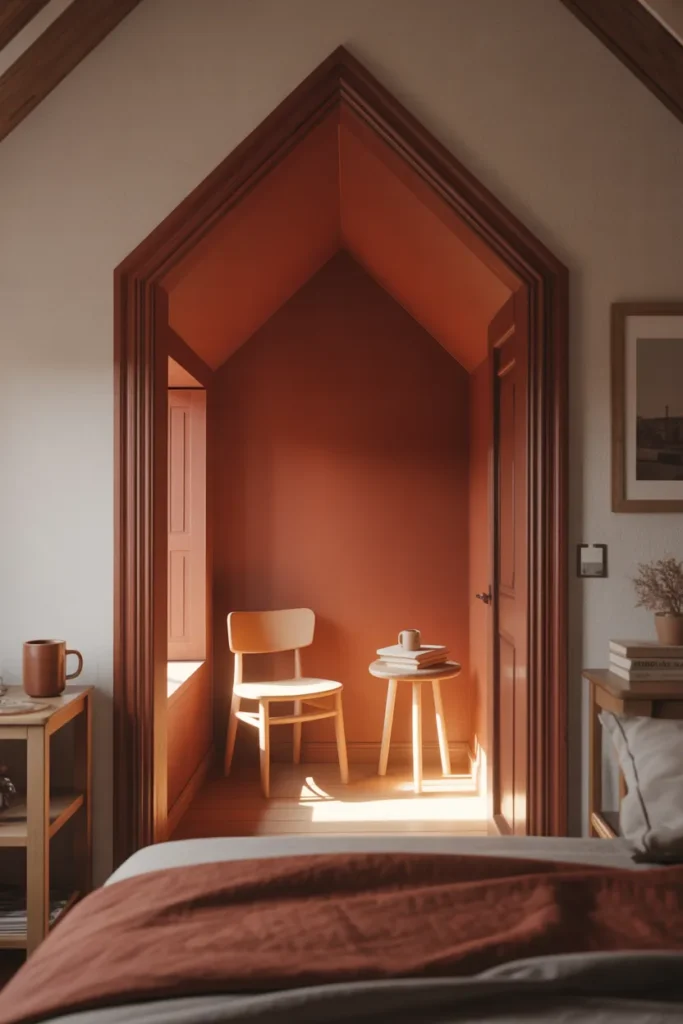
Vibe: Sun-warmed, earthy, concentrated
Why it works: Painting only the dormer recess creates a “room within a room.” The saturated color acts like a frame, drawing attention to the window and making the nook feel intentional.
How to get it: Choose a warm earth tone (Farrow & Ball “India Yellow” or similar). Paint only the inside of the dormer alcove — all three sides and the ceiling of that niche. Leave the main room white.
Shop The Look
| Product | Category |
|---|---|
| Deep ochre matte paint | Paint |
| Simple solid wood side chair | Furniture |
| Handmade terracotta mug | Decor |
| Small round oak side table | Furniture |
| Stack of cream linen-bound books | Decor |
8. Unfinished Plaster Walls
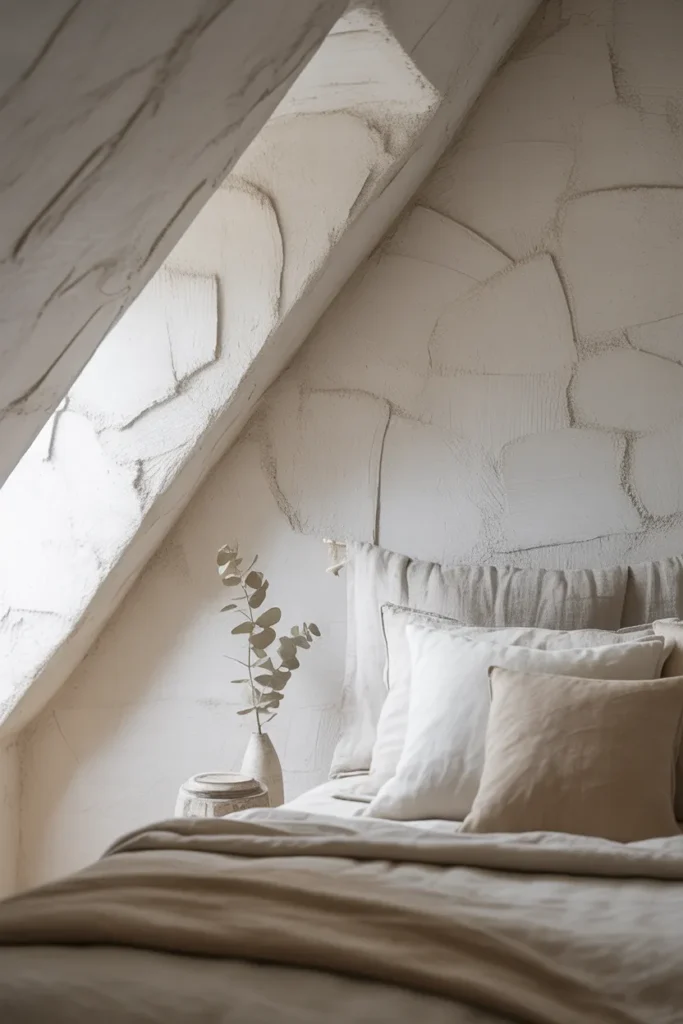
Vibe: Raw, ancient, breathable
Why it works: Imperfect plaster reflects light unevenly, which softens harsh attic angles. The texture also absorbs sound, making a small room feel acoustically calm.
How to get it: Apply limewash plaster (Bauwerk or Portola) with a wide trowel using crossing arcs. Do not sand smooth. The goal is visible stroke marks and patchy color.
Shop The Look
| Product | Category |
|---|---|
| Limewash plaster in warm white | Wall finish |
| Dried eucalyptus bunch | Decor |
| Natural linen curtain panel | Window treatment |
| Wide steel trowel | Tool |
| Unfinished pine floating shelf | Storage |
9. Paper Lantern Cluster
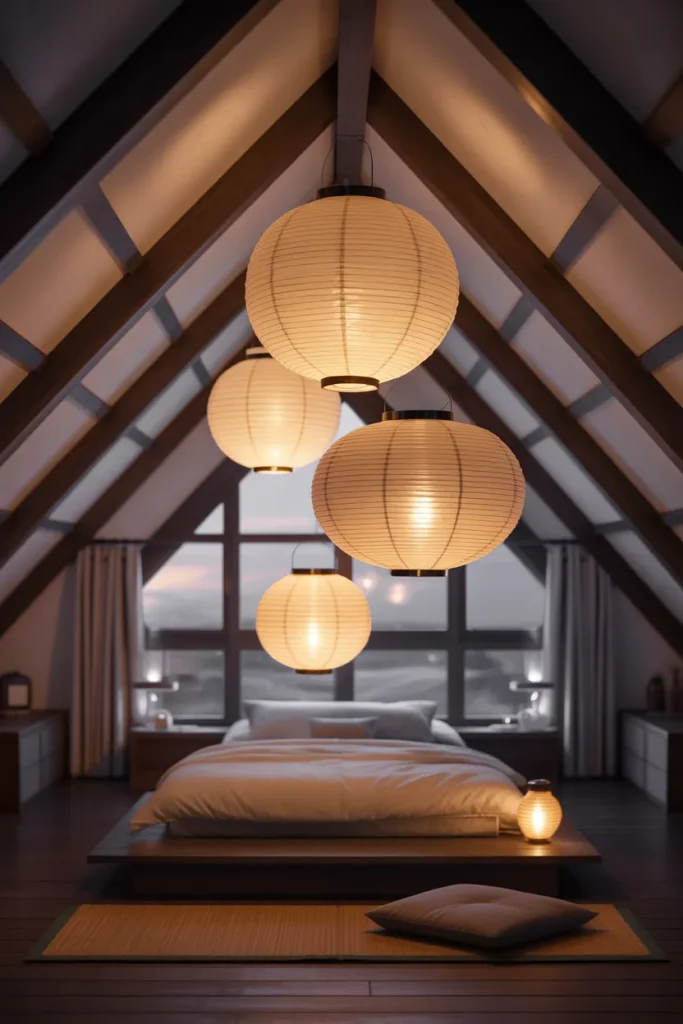
Vibe: Floating, soft, sculptural
Why it works: A cluster of lanterns visually lowers a high peak while keeping the light source soft and shadowless. Their organic shapes contrast with rigid beams and sloped planes.
How to get it: Buy three paper lanterns (one large 20”, two medium 12”). Hang from a single beam using clear fishing wire at staggered heights: 6 inches apart vertically.
Shop The Look
| Product | Category |
|---|---|
| Large paper lantern 20 inch | Lighting |
| Medium paper lantern set of 2 | Lighting |
| Clear fishing wire | Hardware |
| Warm white LED bulb set | Lighting |
| Tatami floor mat | Textile |
10. Deep Green Kneewall
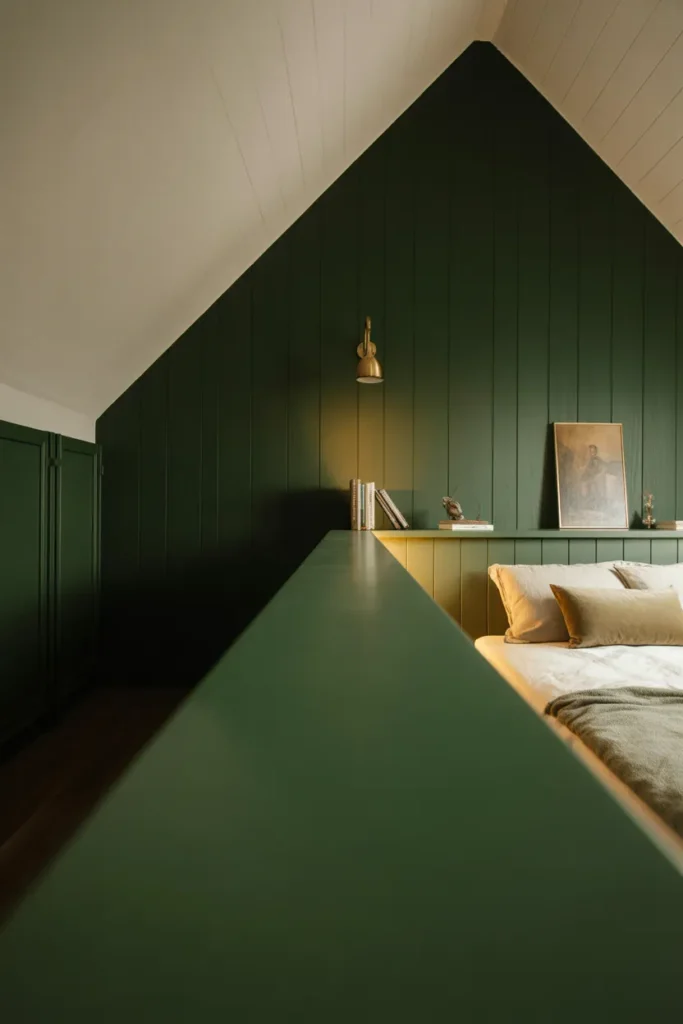
Vibe: Moody, saturated, jewel-like
Why it works: A dark kneewall grounds the room visually and hides dust and scuffs. The white wall above recedes, keeping the room from feeling like a cave despite the deep color.
How to get it: Paint only the kneewall — the short wall under the slope — in a deep matte green (Benjamin Moore “Hunter Green” or similar). Leave every wall above it white.
💡 Quick Win: Place a row of paperback books directly on top of the kneewall. Their uniform height creates a clean line and uses dead space where art cannot hang.
Shop The Look
| Product | Category |
|---|---|
| Forest green matte paint | Paint |
| Brass picture light battery | Lighting |
| Small oil painting floral | Wall art |
| Brass wall sconce plug-in | Lighting |
| Set of vintage-style paperback books | Decor |
11. Rope And Canvas Storage
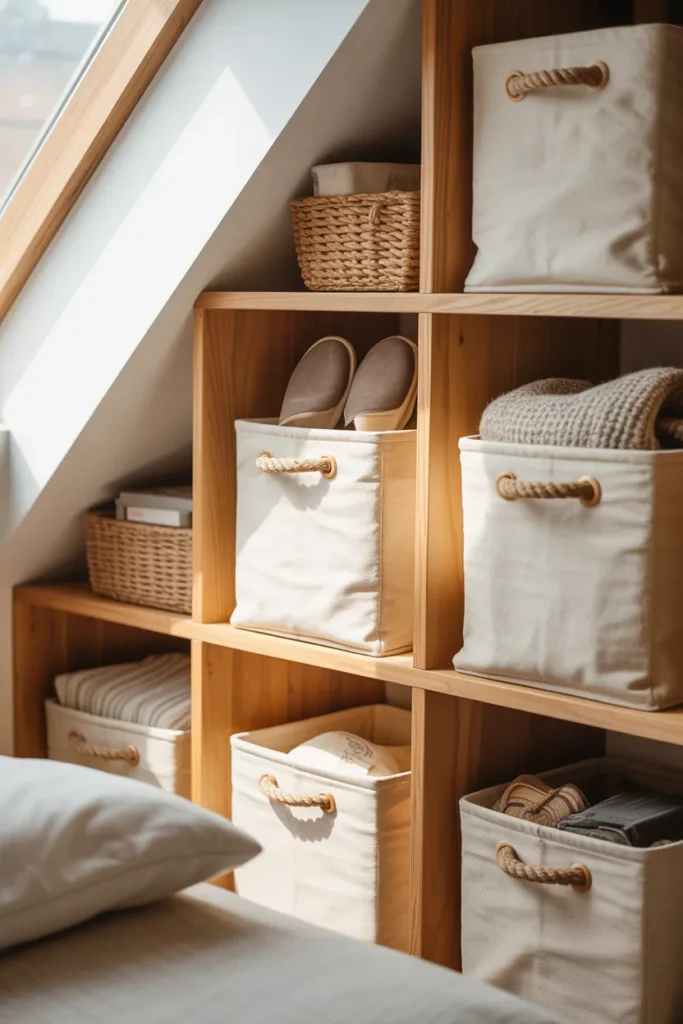
Vibe: Nautical, useful, textured
Why it works: Soft-sided bins fit into odd-shaped eaves cubbies where rigid baskets cannot. Rope handles add an organic, maritime texture that complements raw wood.
How to get it: Measure your eave cubbies (depth x width x height). Buy canvas bins that are 1 inch smaller in each dimension. Replace plastic handles with ¼-inch jute rope.
Shop The Look
| Product | Category |
|---|---|
| Natural canvas storage bin | Storage |
| Thick jute rope (by foot) | Hardware |
| Wool blanket in charcoal | Textile |
| Leather slippers men’s size | Decor (styling) |
| Raw pine cubby shelf unit | Furniture |
12. No Headboard Negative Space
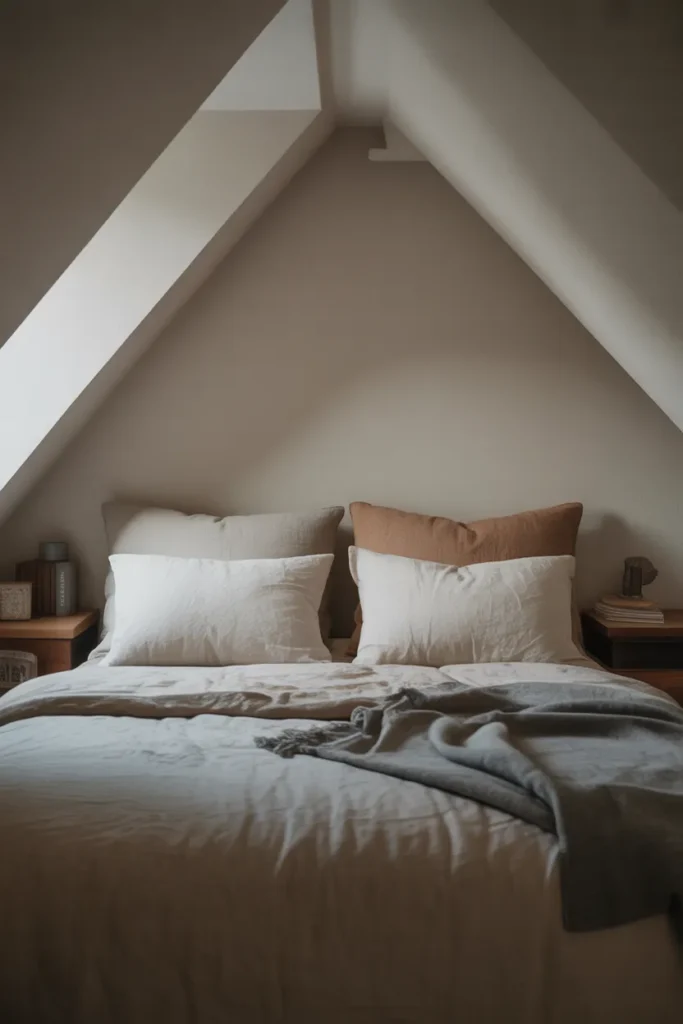
Vibe: Minimal, breathing, uncluttered
Why it works: In a tight attic, a headboard adds visual weight where you need lightness most. Removing it creates negative space that makes the sleeping zone feel open and unpressured.
How to get it: Remove any headboard. Push the bed frame directly against the sloped wall. Use only two pillows stacked. Hang nothing above the bed. Leave that wall completely empty.
Shop The Look
| Product | Category |
|---|---|
| Low profile metal bed frame | Furniture |
| White cotton sateen pillowcases | Bedding |
| Warm grey wool blanket | Textile |
| Natural linen fitted sheet | Bedding |
| Under-bed storage box low profile | Storage |
13.Single Swing-Arm Sconce
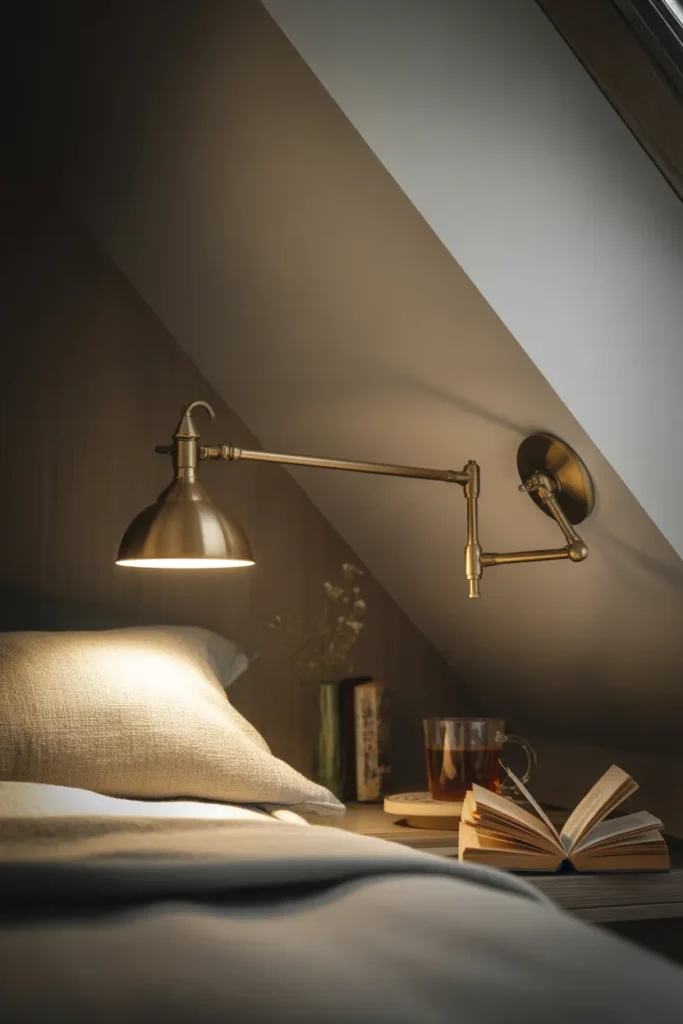
Vibe: Focused, functional, intimate
Why it works: A swing-arm sconce mounted on a kneewall solves the problem of no bedside table space. The arm extends over bedding, delivering task light exactly where needed.
How to get it: Mount a swing-arm sconce on the kneewall at seated eye level. Choose one with an on-arm switch. Position it so the fully extended arm reaches the center of a floor cushion.
💡 Quick Win: Use a plug-in swing-arm sconce with a cord cover painted to match your wall. No electrician required, and you can move it seasonally.
Shop The Look
| Product | Category |
|---|---|
| Brushed brass swing-arm sconce | Lighting |
| Cord cover white paintable | Hardware |
| Floor cushion round thick | Seating |
| Linen sconce shade (replacement) | Lighting |
| LED warm dimmable bulb | Lighting |
14. Sloped Ceiling Full Mirror
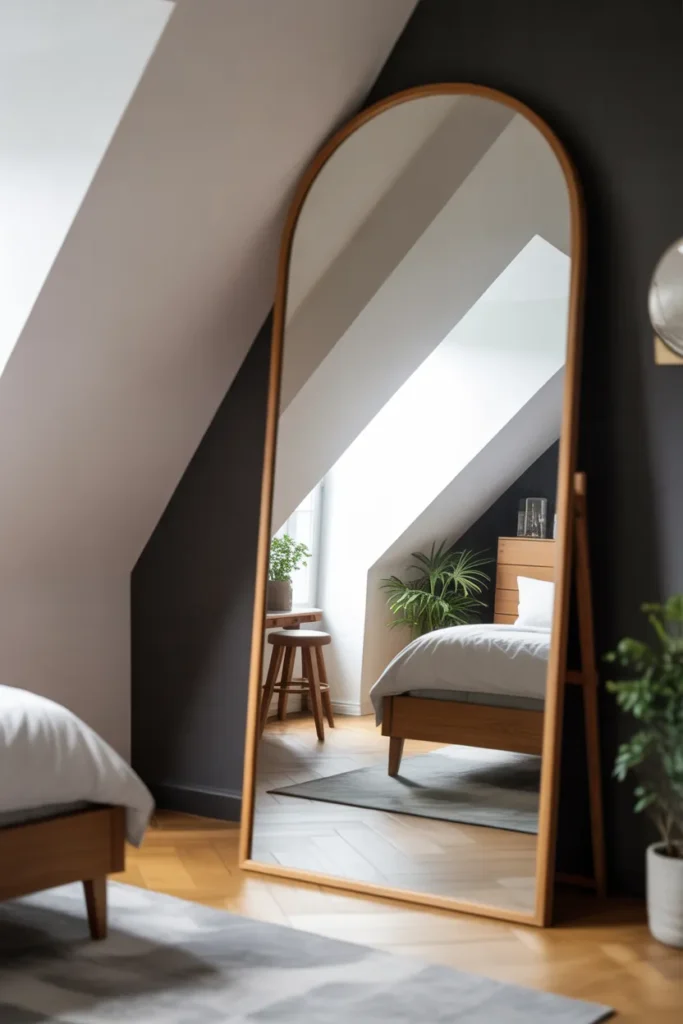
Vibe: Expanding, illusory, bright
Why it works: A large mirror placed on a sloped wall reflects the room’s highest point, visually doubling the ceiling height. The arched shape softens the attic’s many straight lines.
How to get it: Buy a full-length arched mirror (at least 48 inches tall). Lean it against the lowest part of the slope so the top angles forward slightly. Angle it to reflect a window if possible.
💡 Quick Win: Use no-damage mirror hanging strips if you cannot safely lean a mirror. Attach only the bottom edge so the top still angles away from the wall slightly.
Shop The Look
| Product | Category |
|---|---|
| Arched full-length mirror wood frame | Decor |
| No-damage mirror hanging strips | Hardware |
| Small natural wood stool | Furniture |
| Potted snake plant medium | Decor |
| Floor cushion in natural cotton | Seating |
15. Batten And Board Accent
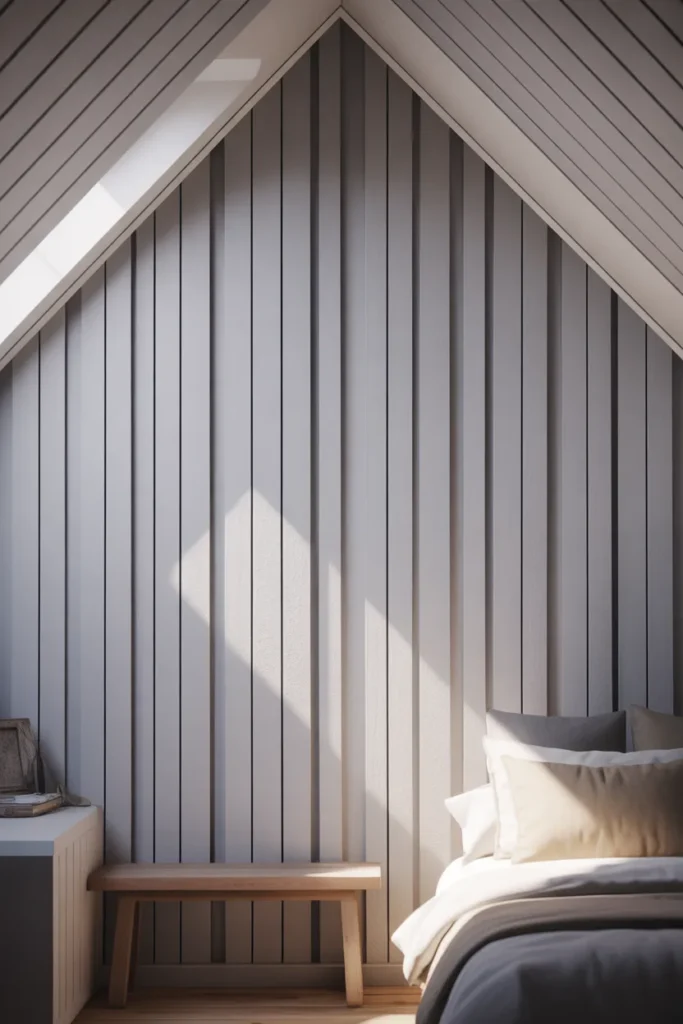
Vibe: Architectural, rhythmic, cottage-like
Why it works: Vertical battens emphasize the height of a gable wall, drawing the eye up to the peak. The repetitive rhythm creates order without adding color or clutter.
How to get it: On one tall gable wall only, attach 1×2 primed pine boards vertically, spaced 12 inches apart. Paint everything — wall and battens — the same matte white.
Shop The Look
| Product | Category |
|---|---|
| Primed 1×2 pine boards (8 ft) | Wall covering |
| Matte white paint (gallon) | Paint |
| Simple oak bench 36 inch | Furniture |
| Cream linen bench cushion | Textile |
| Battery nail gun (rental) | Tool |
16. Wool Rug Over Sisal
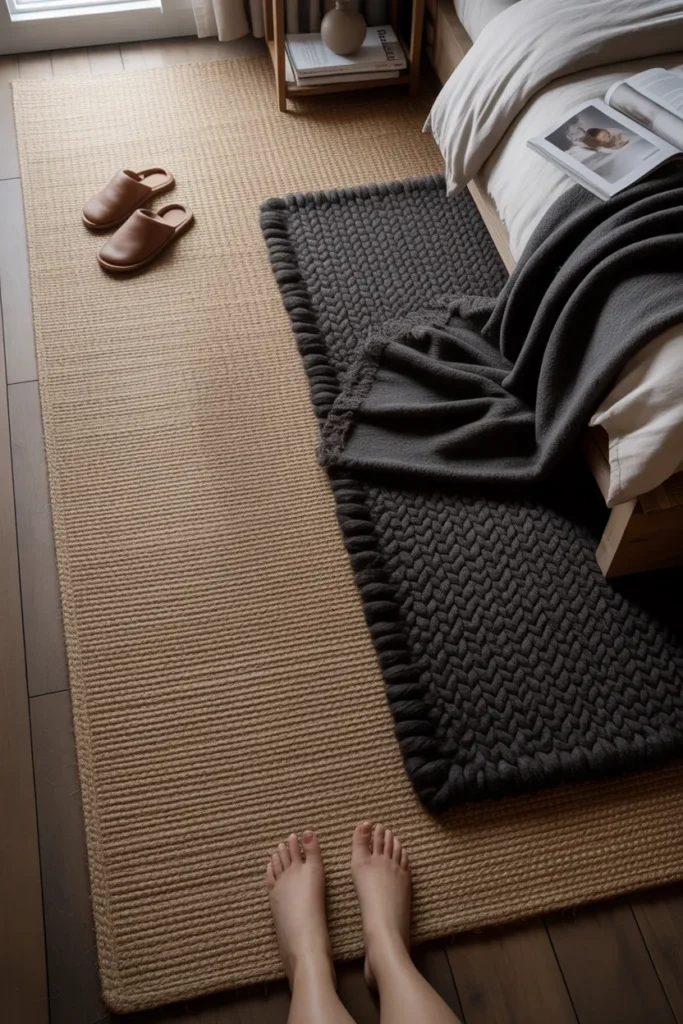
Vibe: Layered, cozy, insulated
Why it works: Sisal provides a large, neutral foundation that hides attic floor imperfections. A smaller wool rug on top adds softness underfoot and defines the bed zone.
How to get it: Buy a sisal rug that comes within 12 inches of all walls. Buy a wool rug one size smaller. Place the wool rug at a 45-degree angle or parallel, overlapping the sisal by at least 6 inches.
Shop The Look
| Product | Category |
|---|---|
| Natural sisal rug 8×10 | Textile |
| Charcoal wool rug 5×7 | Textile |
| Felt rug pad for sisal | Supplies |
| Leather slippers unisex | Decor (styling) |
| Rug tape double-sided | Hardware |
17.Dried Botanical Ceiling Hang

Vibe: Whimsical, organic, airy
Why it works: Hanging botanicals draws the eye upward and softens the hard line of a beam. Dried materials last for years and add organic shapes to a rectilinear attic.
How to get it: Gather 5 to 7 bunches of dried eucalyptus or dried lavender. Tie with twine and hang from cup hooks screwed into a beam at varied lengths. Hang over the foot of the bed.
Shop The Look
| Product | Category |
|---|---|
| Dried eucalyptus bunch set | Decor |
| Bunny tail grass dried bunch | Decor |
| Natural jute twine roll | Supplies |
| Small brass cup hooks | Hardware |
| White linen duvet cover | Bedding |
How to Start Your Attic Bedroom Transformation
Your single first move is lighting the darkest corner first. Before you buy bedding or paint, install one plug-in sconce or a floor lamp in the farthest, dimmest point of your attic. Attics fail as bedrooms not because of low ceilings but because of shadow caves. One well-placed light source at the room’s deepest edge will immediately expand the usable space. Everything else — paint, rugs, furniture — builds from that one decision.
The most common mistake is over-furnishing the center. Beginners buy a queen bed, two nightstands, a dresser, and a chair, then discover nothing fits. An attic bedroom is not a primary suite. Fix this by measuring every slope height before you buy anything. If the ceiling is under 40 inches high at the wall, that zone cannot hold furniture — only storage or cushions. Edit down to three pieces maximum: bed, one surface, one seat.
Budget entry points under $50 that create immediate impact: a single dried eucalyptus bunch to hang from a beam ($12), a brass cup hook set to hang lanterns or robes ($8 for 6), and a natural jute rope to replace plastic handles on existing storage bins ($6 per foot). These three items cost under $30 combined but instantly shift the room from “storage space” to “intentional retreat.”
A full attic bedroom transformation typically takes 2 to 3 weekends, not counting furniture delivery. The first weekend handles paint and lighting installation. The second weekend adds flooring (or rugs) and bed assembly. The third weekend layers textiles and styling. Budget realistically: a starter version using existing furniture plus paint, rugs, and lighting runs $500–$800. A full gut renovation with new floors, custom storage, and all new furniture starts at $3,000 and can exceed $10,000 for large attics.
Frequently Asked Questions About Attic Bedroom Ideas
What is the difference between an attic bedroom and a loft bedroom?
An attic bedroom sits directly under the roof slope, meaning at least one wall is a kneewall (under 4 feet tall) and the ceiling slopes on two or more sides. A loft bedroom is an open sleeping area within a larger room, usually with a flat ceiling and a railing. Attic bedrooms require specific solutions for slope clearance and ventilation that lofts do not need.
How do I choose paint colors for a dark attic with no windows?
Prioritize reflectance values (LRV) above 70 for walls if you have no windows — think Benjamin Moore “Simply White” (LRV 89) or “White Dove” (LRV 83). Avoid cool grays and blues which read as dingy in low light. If you want color, keep it to one accent wall or kneewall only, and keep the ceiling and remaining walls in high-LRV white.
How much does it cost to convert an attic into a bedroom professionally?
A basic conversion (insulation, drywall, one egress window, basic electrical) averages $20,000 to $50,000 depending on region and attic size. Adding a bathroom or raising the roof structure pushes costs to $75,000–$120,000. A DIY cosmetic conversion (paint, lighting, rugs, furniture) can stay under $2,000 if the space is already insulated and has legal ceiling height.
Can an attic bedroom meet building codes for a legal bedroom?
Yes, but only if it meets three requirements: minimum ceiling height of 7 feet over at least 50% of the floor area, a second means of egress (a window at least 5.7 square feet with a sill under 44 inches), and a smoke detector hardwired to the home’s system. Many attics do not qualify without structural changes, so check local codes before planning a rental conversion.
How do I ventilate an attic bedroom without losing conditioned air?
Install a solar-powered roof vent fan that activates only when the attic space exceeds 90 degrees. For passive ventilation, add operable skylights or dormer windows on opposite sides of the roof to create cross-breeze. Never seal an attic bedroom completely — stack effect from lower floors will pull moisture upward, leading to mold behind kneewalls.
Ready to Create Your Dream Attic Bedroom Retreat?
You’ve explored 17 distinct approaches — from color-drenched shadows to paper lantern clusters and low platform beds — each designed to solve a different attic challenge. Transforming an awkward, sloped space does not require a construction crew; it starts with a single lamp in the darkest corner and grows one intentional choice at a time. Today, walk into your attic with a tape measure and a notebook: write down the height at the lowest beam and the location of the farthest shadow. Once your attic bedroom is finished, you will feel something rare — the deep, quiet satisfaction of a room that fits you exactly, not because it is large, but because it is yours. Pin your favorite idea from these 17 to your “Dream Attic” board now — whether it is the rope-handled bins, the limewash plaster, or that single green kneewall, save the image before the inspiration slips away.
One Comment